Showing posts with label travel in space. Show all posts

Sunday, April 13, 2008

Entrepreneur talks space travel
image

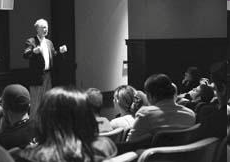
Greg Olsen, scientist, businessman and astronaut, came to the College on March 26 to tell his story in the New Library Auditorium.

Olsen nearly flunked out of high school, failing trigonometry and graduating with an overall average of 70. Coaxed into college, Olsen received his Bachelor of Science in electrical engineering and a master's degree in physics from Fairleigh Dickinson University. A doctorate in materials science from the University of Virginia followed afterwards.

From 1972-1983, Olsen worked as a research scientist for RCA labs. It was here where he got the idea to start his first company, Epitaxx.

"I had no background in business … until 1983 when I got the idea to start this tech company," Olsen said.

With $1.5 million in startup funds, the company focused on making fiber-optic detectors and soon employed up to 55 people and made $5 million a year. The company was bought out by Japanese company Nippon Sheet Glass for $12 million in 1990.

"In 1990 everybody thought Japan was going to rule the world economically," Olsen said. "We all hear about India and China now … Anybody who thinks the U.S. is gonna get left in the dust, just remember what happened in 1990."

Olsen started his second company, called Sensors Unlimited, in 1992. Sensors Unlimited was sold for $600 million in 2000 but Olsen bought the company back a year later for $6 million and later re-sold it for $60 million in 2003.

It was in June of that year that Olsen got the idea to travel into space.

"The inspiration to go to the International Space Station (ISS) came from this," Olsen said, holding up his coffee cup. "Every morning you can find me at the Starbucks on Nassau Street (in Princeton) reading the paper."

It was a chance reading during one particular Starbucks trip that introduced Olsen to Dennis Tito and Mark Shuttleworth, the first two private citizens to board the ISS.

"Have you ever had that feeling where you've seen something and you said to yourself, 'I have to do this?'" Olsen asked.

By April of 2004 Olsen was in Russia training for his spaceflight. In June of that year he was disqualified for having a black spot on his lung.

"That was a devastating experience for me," Olsen said.

He got clearance from American doctors, and pressed the issue with the Russian doctors until he was allowed back into the program in May 2005.

"By February I didn't think that I would get to fly into space, but I just kept at it," Olsen said.

In October of that year, he and two other astronauts launched from Russia.

Olsen showed videos of his trip on the ISS with instructions on how to drink water and eat food. He also demonstrated basic properties of physics using a floating notebook.

Of his experience, Olsen said he was happy with how everything turned out.

"I don't consider myself an astronaut, but I feel like I was properly trained," he said.

Currently, Olsen is the chief executive officer of GHO Ventures and, in addition to managing a winery in South Africa and a ranch in Montana, he funds "Angel Projects," which are startup companies that he believes show promise.

"I love startups," Olsen said. "I thought, why don't I try investing in others?"

By Cameron Prince

Tuesday, March 4, 2008

The Stars: Our Destination

Vacations in space and time

Forty years ago it was “one small step for man, one giant leap for mankind.” Now it is a small step for anyone who dares.
For the last four decades, space flight has been neglected as a primary conduit to human evolution. Popular opinion sees space flight as a sidebar to human development. Even NASA, with their use of aging, decrepit and obsolete shuttles, appears to believe the same. But fear not, for our savior has arrived in the form of a virgin. Well, the Virgin Galactic program that is. Virgin has taken the initiative in commercializing space

Image courtesy of virgin galactic, design by sky 26
travel as a luxury for those who can afford it

image

The dream of everyday space flight has been around a long time. But, while science fiction has been escalating in the last decade with advanced computer-generated graphics, society has largely forgotten actual space exploration. In the mid-20th century, the United States and the former Soviet Union were feverishly involved in pushing space exploration. It seemed that, like in Star Trek, space exploration was best executed by the government.
In the 1980s, NASA began to launch shuttles that took off from and landed on Earth more than once. These shuttles cut down on the cost of development. The down side of the shuttle, however, was they offered no progression. The need to develop new models was minimal.
Since then, however, the idea of international cooperation has inspired multiple governments to join together and build the International Space Station. Bent on scientific discovery rather than territorial expansion, the station has ended much of the exploration being done by governments. The weight of exploration is now left to the private sector. With little room being left on Earth to expand empires, corporations like Virgin have seized the opportunity to expand their market into space. It offers free expansion as no one currently owns space.
Further initiative came from the Ansari X prize. It inspired innovators and dreamers to build the first commercial sub-orbital space craft. Many competitors strove to reach the goal and win the prize: $10 million. It was a company named Scaled Composites, founded by Burt Rutan, that eventually designed the winner. Named SpaceShipOne, it flew at an altitude of more than 100 kilometres. The design of SpaceShipOne is simple and efficient, which makes it significantly less expensive than NASA’s fuel-guzzling shuttles.
SpaceShipOne uses a form of biofuel. The fuel is practical enough to allow the ship to reach sub-orbit, but requires less than half of what a normal shuttle does. To achieve optimal efficiency, Scaled Composites attached the SpaceShipOne to WhiteKnightOne, an aircraft. Instead of launching from the ground, ShipShipOne launches after becoming airborne. This technique allows for even more efficiency.
The ship’s efficiency was what drew Virgin’s Sir Richard Branson. The company was inspired to begin its own attempts at building a commercially viable passenger space craft. Based on the SpaceShipOne’s design, SpaceShipTwo has become Virgin Galactic’s platform for allowing private citizens to visit space.
“It was Stephen Hawking who first got me thinking about this issue when he explained clearly and concisely to the BBC that mankind had no option but to get to space as quickly as possible and start doing things up there that we have been doing on planet Earth, but in a much more efficient manner,” Branson said at SpaceShipTwo’s unveiling.
Branson seemed sincere when he said that space flight is essential to human development. Without prospects of commercial success, however, Virgin Galactic would be unable to justify their investment to stockholders.
That profit requirement means a ticket to space does not come cheap. Current pricing places the cost of a ticket at $200,000 US a seat. The ticket will buy tourists a several minute journey at sub-orbital altitudes.
Though the initial price of a ticket will prove far out of reach for most consumers, it is expected to incrementally decrease as the program continues to pick up speed. After a few years and a few hundred people, the price of a ticket will most likely go down to $20,000 US a piece.
There are others, however, who are finding a way around paying the hefty fee. A British businessman was able to exchange two million Air Miles points for a ticket aboard one of the first flights. However, for the majority of people, $20,000 is far too expensive, even if it is to witness something as spectacular as seeing planet Earth from space. 
Yet Branson sees this as just the beginning of better things to come for the industry.
“With the end of the oil era approaching and climate change progressing faster than most models have been predicting, the utilization of space is essential not only for communications but also for the logistics of survival through things such as weather satellites, agricultural monitoring, GPS and climate science.”
Not only would space be a reasonable way to guarantee survival of the species, it would also guarantee optimal profit should Virgin Galactic hold a monopoly on commercial space flight. However, without a profit, there would be no motivation for space tourism in the first place.
Several companies, such as Rocketplane Limited, Space Adventures and EADS Astrium, have announced their intention to be commercial spaceflight agencies. There is no doubt that in the future, spaceflight will become a standard of travel.
For Virgin Galactic, however, tourism is just the beginning. The company will most likely expand from tourism to a more lucrative industry like transportation from one side of the Earth to the other. Instead of taking a day to travel to Japan, a spaceship capable of holding up to 100 passengers could cut that time significantly.
The advantages of commercial space flight are numerous. Its ability to push innovation is already taking the place of NASA. Government will always play a role to some degree, but ventures such as asteroid mining, solar energy collectors and colonization will be ideal for corporations to invest their time and money into because of the potential for maximum profit.
Although governments could plan and build environments on other planets to house humans, it would be capitalism that forces the economy and infrastructure. What drives people to exotic places is not just a sense of adventure but, like with any new frontier, the possibility of discovering a better life with better job opportunities. Those jobs will be provided by companies like Virgin.
Relatively speaking, there are still more than enough complications prolonging spaceflight developments. While interplanetary exploration is accepted as a future prospect for mankind, interstellar spaceflight is a bit more complicated with the vast gaps between stars. It would currently take centuries to get to the nearest star systems using the most powerful propulsion methods currently available. Though most of us will not be able to see the interstellar steps, we will be alive to see the first true steps of space exploration.


Written by Brent Rose, Contributor

Friday, December 7, 2007

G.A.P Adventures takes travellers to the edge of space

After years of providing travellers with the most exciting, innovative adventures in the world, G.A.P Adventures is now helping people experience our planet’s last frontier—space. With the launch of these three new Space Experiences, G.A.P Adventures can now cater to those travellers whose wanderlust extends beyond this world.

“Making new and thrilling travel experiences available to people has driven G.A.P Adventures to every corner of the globe,” said G.A.P Adventures CEO Bruce Poon Tip. “I am proud that we now also cater to travellers who not only look up into the night’s sky with open eyed curiosity, but want to experience it first-hand. For G.A.P Adventures it was never a question of if we could provide our travellers with the experience of undertaking space travel, but when.”

G.A.P Adventures new Space Experiences include:

Russia Space Adventure – The Edge of Earth: Would be astronauts no longer require a degree in astrophysics or a million dollar bank account to be able to view the earth’s curve from 60,000 ft with G.A.P Adventures new Russia Space Adventure. Travellers will be taken to the upper reaches of earth’s atmosphere in a MIG-31 Jet Fighter to experience the edge of space itself.

When their feet finally touch the ground, travellers on this adventure will be able to explore remnants of the vast aviation history that placed the then Soviet Union on the world map. The Monino Air Museum, just outside of Moscow, houses some of the oldest aircrafts in the former Soviet Republic. This three-day trip concludes with a chance for travellers to immerse themselves in the many sights of fascinating Moscow, with the third day acting as a back-up flight day in case of poor weather conditions.

Zero Gravity Adventure: G.A.P Adventures has a tour that allows travellers to experience zero gravity first-hand. After exploring Moscow, tour members will be transported to the Chkailovsky Air Base, located just outside of Moscow. After one day of cosmonaut training, they will fly 34,000ft into the atmosphere to experience zero gravity. Once the proper altitude is reached of this remarkable flight, weightlessness takes control and the travellers will feel as though they were in space itself.

Cosmonaut for a Day: If you don’t want to fly to 60,000 ft but would still like to experience life as a cosmonaut, then G.A.P Adventures has the ideal tour. The five-day “cosmonaut training package” provides the opportunity to train like a real Russian cosmonaut, from eating space food to experiencing space simulators. Also included is an opportunity to explore the immense aviation history of Russia and the many tourist attractions of Moscow. This unique tour allows travellers to experience what is required for life in space, without having to leave earth.

G.A.P Adventures has committed itself to providing the public with unique and accessible travel experiences. The three new Space Experiences will take travellers closer to space than ever before. For more information visit Gapadventures.com.