Showing posts with label Richard Garriott. Show all posts

Wednesday, May 21, 2008

Cover Story

Wanted: an Emirati space tourist
image

ANY Emirati with $35 million to spare is being encouraged by Space Adventures to contact the orbital space flight company to join them on a mission to the International Space Station (ISS).

CEO and president of Space Adventures Eric Anderson, who was in Dubai for the recent WTTC Summit, told TTN’s in an exclusive interview that the company would particularly welcome an Emirati recruit to go orbital.

“The kind of astronaut I’m looking for is someone who would go into orbit – spend two weeks on the International Space Station,” said Anderson.

“They would have to have a reasonable level of fitness; they will have to find a little bit of time in their schedule because there are about 12 to 14 weeks of training required.”

Space Adventures is targeting private individuals, business people, and has spoken to organisations and sectors of the government while here. “We are just starting discussions about it now,” said Anderson.

So far the company has had five private citizens visit the ISS, and the sixth, video game programmer and designer and Texas resident Richard Garriott, is due to take off from the steppes of the Kazakhstan space port on October 12.

“Garriott is unique as he is going to be the world’s second generation astronaut - his father is Owen Garriott is a former NASA astronaut,” he said.

Although the focus of the company is on orbital flights, they also offer sub-orbital flights costing around $200,000 for the blast. Rockets boost passengers 100 kilometres up to where space begins. After the engines shutdown, participants experience up to five minutes of continuous weightlessness, and can see Earth below.

Other space companies – Virgin Galactic for example, have signed up five Emiratis so far for sub-orbital flights. UAE national Adnan Al Maimani, a Space Adventures client, was the first to sign up and is on a waiting list for a sub-orbital flight.

“Sub-orbital is really the edge of an orbital flight. We think that if someone is going to pay $200,000 for a few minutes on the edge of space, we would love to see more people doing it. If someone is keen to go that far they possibly really want to go to the space station. It’s a teaser. So we are very supportive of sub orbital flights and we don’t really think of others as opposition,” Anderson said.

Space Adventures recently acquired another company called Zero Gravity. “We have come to realise over the last couple of years that this is the best space experience for the rest of us, so to speak. The Zero Gravity is a $4,000 per person space experience. It is not a space flight per se, but it is a two hour flight in a specially outfitted Boeing 727 during which participants have short periods of weightlessness,” he said.

“Zero gravity flights are really a much better option than sub-orbital because you get more weightlessness and you are in an FAA approved aircraft. It is also a lot less expensive.”

Another advantage of zero gravity flights was that these fly out of regular airports anywhere in the world. So what if we want to bring it to Dubai?

“Absolutely, we could bring it right here. We would have to have a group of committed customers before we did that, but we may well do that at some point,” he said.

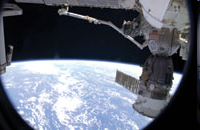
The United States, Russia, Japan, Canada and Europe share the ISS international project. Construction started in November 1998, and is scheduled for completion in 2010. It orbits at an average altitude of 354 kilometres at an inclination of 51.6 degrees to the equator and at 17,000 miles an hour.

by Cheryl Mandy
Tuesday, April 8, 2008

Next Space Tourist Takes Break from Spaceflight Training

By Tariq Malik

NEW YORK - The next space tourist bound for the International Space Station (ISS) is taking a breather from spaceflight training as he prepares to ride a Russian rocket toward the orbiting laboratory later this year.

American computer game developer Richard Garriott, 46, has returned to the U.S. after an intense six weeks of Russian classes and Soyuz spacecraft training for his planned October flight to the ISS. The one-month rest comes between a series of trips to Russia's cosmonaut training center in Star City, where he and backup Nik Halik have been wading through the intricacies of Soyuz spaceflight.

"In the Soyuz, all of the buttons and things are labeled in Russian, so you need to be able to read and understand a few technical words," Garriott told SPACE.com Friday, adding that he spent four hours each day learning the new language. "There's no question that learning Russian is a little bit of a challenge."

Based in Austin, Texas, Garriott is paying about $30 million to fly to the ISS with two professional astronauts in October under an agreement between Russia's Federal Space Agency and the Virginia-based tourism firm Space Adventures, which brokered the flight. He plans to conduct Earth observations and protein crystal growth experiments during his mission and launched an educational contest for British students to devise their own tests that he could perform.

In between language lessons, Garriott and Halik spent four hours each day studying Soyuz spacecraft training manuals and exploring Russia's Gagarin Cosmonaut Training Center.

"One of the things that I didn't know was there while we were kicking around was that they have a wonderful planetarium," Garriott said, adding that he and Halik hope to visit the planetarium during their next training session. "It's a surprisingly open place."

The two entrepreneurs were careful to keep out of restricted zones and adhere to training protocol. Russian space officials recently replaced South Korea's first astronaut choice, artificial intelligence expert Ko San, for an April 8 launch due to regulation infractions. Ko's backup, female mechanical engineer Yi So-yeon, will take his place during the upcoming spaceflight.

Halik, 38, is an Australian entrepreneur who is paying $3 million to serve as Garriott's backup and experience genuine spaceflight training.

"Though Nik and I had not really known each other before training together in Star City, it turns out we've lived very parallel lives," said Garriott, adding that both he and his backup have taken adventure trips to Antarctica, rode aboard submersibles down to the wreck of the Titanic, experienced weightless on aircraft and flown Russian MiG jets. "Because we have that same adventurous spirit and similar background, training together has been actually really convenient and also given us a well-rounded opportunity to share this experience together."

Garriott developed the Ultima computer game series and co-founded the Origins Systems computer game company as well as the North American branch of the online game developer NCsoft. He hopes to spend his month off from training to catching up with his work. But, Garriott added, he did happen to be in Russia training for spaceflight in early February, when his most recent game "Tabula Rasa" hit stores in Moscow in its Russian packaging.

"Getting a chance to sit down with the players was actually great fun for me and hopefully they enjoyed it as well," Garriott said.

Garriott has expressed an interest in paying an extra $15 million to stage the first spacewalk by a private spaceflyer, though whether the activity could come together in time for his flight is up in the air. He has already been fitted for his Russian Sokol spacesuit, the partial pressure garment that he will wear during launch and landing, but not one worthy of a spacewalk.

"Of course I would love to do it if it could be done," said Garriott, adding that he hopes to put together some sort of simple, feasible science experiment in case it opportunity arises.

Garriott will be the sixth paying visitor to the ISS, but the first American second-generation spaceflyer to reach orbit. His father, Owen Garriott, is a retired NASA astronaut who flew aboard the U.S. Skylab space station and shuttle Columbia, and will serve as chief scientist for the coming spaceflight.

"One of the more interesting aspects of working with my father on this flight is what an appreciation it's given me for the challenges that my dad faced during his time with NASA," the younger Garriott said. "The sense of urgency to get all your ducks in a row and get things lined up appropriately has been high."

Richard Garriott is chronicling his spaceflight training and mission at his personal Web site: www.richardinspace.com.

Space Adventures' Orbital Spaceflight Client, Richard Garriott, Announces Educational Partnership with Challenger Center for Space Science Education

Richard Garriott is a preeminent game developer and son of NASA Skylab Astronaut Owen Garriott.  As the next civilian to fly into space, Richard plans to follow the lead of Educator Astronaut Barbara Morgan, STS-118, through interactive lessons that will motivate and inspire students.  His flight is currently scheduled for lift-off to the International Space Station on October 12, 2008.  Richard is a former student of Dr. June Scobee Rodgers, the Founding Chairman of Challenger Center for Space Science Education and widow of that flight's Commander, Dick Scobee.  After the tragic loss of the Challenger space shuttle crew, Richard worked with Dr. Scobee Rodgers on the design of the first Challenger Learning Center.  There are now over 50 Challenger Learning Centers in the United States, Canada, England and South Korea.  Richard will continue the mission of Teacher-in-Space Christa McAuliffe, as did Barbara Morgan, as he delivers activities and challenges from the International Space Station.  Garriott's flight activities have the potential to reach children across the globe as he reaches out from the first Challenger Learning Center off the planet.

Garriott plans to spend time before, during and after his flight working with students, teachers and the 50 Challenger Learning Centers located in the United States, England, Canada and South Korea. He plans to conduct a series of interactive webcasts associated with his spaceflight training in Russia; conduct podcasts discussing activities related to both his training and spaceflight; hold amateur ham radio conversations with students during his flight; and perform experiments that can be replicated by students using everyday objects to demonstrate important concepts in physics. Students can predict what might happen during the same experiment in the microgravity (weightless) environment of space. 

Dr. June Scobee Rodgers plans to present lessons to students over the web in preparation for Richard Garriott’s flight. “Like father, like son,” says Dr. Rodgers, commenting on her former student's plans. “Dr. Owen Garriott also taught student science lessons from space on his Skylab mission, as Richard plans to do on his flight.” Richard Garriott’s experiments, webcasts, and podcasts about his flight will be available on the Challenger Center’s national website, www.challenger.org.

Challenger Center for Space Science Education was founded in 1986 by the families of the astronauts of the space shuttle Challenger 51-L mission. It is dedicated to the educational spirit of that mission and impacts over 300,000 students and 25,000 teachers each year. Challenger Learning Center programs at 50 centers around the world continue the crew's mission of engaging teachers and students in science, mathematics, engineering and technology. To locate a Challenger Learning Center near you, visit www.challenger.org.

Tuesday, March 25, 2008

Next Space Tourist Takes Break from Spaceflight Training


image

NEW YORK - The next space tourist bound for the International Space Station (ISS) is taking a breather from spaceflight training as he prepares to ride a Russian rocket toward the orbiting laboratory later this year.

American computer game developer Richard Garriott, 46, has returned to the U.S. after an intense six weeks of Russian classes and Soyuz spacecraft training for his planned October flight to the ISS. The one-month rest comes between a series of trips to Russia's cosmonaut training center in Star City, where he and backup Nik Halik have been wading through the intricacies of Soyuz spaceflight.

"In the Soyuz, all of the buttons and things are labeled in Russian, so you need to be able to read and understand a few technical words," Garriott told SPACE.com Friday, adding that he spent four hours each day learning the new language. "There's no question that learning Russian is a little bit of a challenge."

Based in Austin, Texas, Garriott is paying about $30 million to fly to the ISS with two professional astronauts in October under an agreement between Russia's Federal Space Agency and the Virginia-based tourism firm Space Adventures, which brokered the flight. He plans to conduct Earth observations and protein crystal growth experiments during his mission and launched an educational contest for British students to devise their own tests that he could perform.

In between language lessons, Garriott and Halik spent four hours each day studying Soyuz spacecraft training manuals and exploring Russia's Gagarin Cosmonaut Training Center.

"One of the things that I didn't know was there while we were kicking around was that they have a wonderful planetarium," Garriott said, adding that he and Halik hope to visit the planetarium during their next training session. "It's a surprisingly open place."

The two entrepreneurs were careful to keep out of restricted zones and adhere to training protocol. Russian space officials recently replaced South Korea's first astronaut choice, artificial intelligence expert Ko San, for an April 8 launch due to regulation infractions. Ko's backup, female mechanical engineer Yi So-yeon, will take his place during the upcoming spaceflight.

Halik, 38, is an Australian entrepreneur who is paying $3 million to serve as Garriott's backup and experience genuine spaceflight training.

"Though Nik and I had not really known each other before training together in Star City, it turns out we've lived very parallel lives," said Garriott, adding that both he and his backup have taken adventure trips to Antarctica, rode aboard submersibles down to the wreck of the Titanic, experienced weightless on aircraft and flown Russian MiG jets. "Because we have that same adventurous spirit and similar background, training together has been actually really convenient and also given us a well-rounded opportunity to share this experience together."

Garriott developed the Ultima computer game series and co-founded the Origins Systems computer game company as well as the North American branch of the online game developer NCsoft. He hopes to spend his month off from training to catching up with his work. But, Garriott added, he did happen to be in Russia training for spaceflight in early February, when his most recent game "Tabula Rasa" hit stores in Moscow in its Russian packaging.

"Getting a chance to sit down with the players was actually great fun for me and hopefully they enjoyed it as well," Garriott said.

Garriott has expressed an interest in paying an extra $15 million to stage the first spacewalk by a private spaceflyer, though whether the activity could come together in time for his flight is up in the air. He has already been fitted for his Russian Sokol spacesuit, the partial pressure garment that he will wear during launch and landing, but not one worthy of a spacewalk.

"Of course I would love to do it if it could be done," said Garriott, adding that he hopes to put together some sort of simple, feasible science experiment in case it opportunity arises.

Garriott will be the sixth paying visitor to the ISS, but the first American second-generation spaceflyer to reach orbit. His father, Owen Garriott, is a retired NASA astronaut who flew aboard the U.S. Skylab space station and shuttle Columbia, and will serve as chief scientist for the coming spaceflight.

"One of the more interesting aspects of working with my father on this flight is what an appreciation it's given me for the challenges that my dad faced during his time with NASA," the younger Garriott said. "The sense of urgency to get all your ducks in a row and get things lined up appropriately has been high."

Richard Garriott is chronicling his spaceflight training and mission at his personal Web site: www.richardinspace.com.

Wednesday, February 20, 2008

An interview with Richard Garriott

An interview with Richard Garriott
by Sam Dinkin

image

Space tourist Richard Garriott during a zero-g airplane flight last year. Garriott is scheduled to fly to the ISS this fall. (credit: richardinspace.com)

[Editor’s note: the following is an edited version of an email interview between Sam Dinkin and Richard Garriott, a developer of computer games like Tabula Rasa who is currently in Russia training to be the next commercial visitor to the International Space Station this fall.]
Mind and skills

Sam Dinkin, The Space Review (TSR): Are you finding some parallels in your final training with the player experience in Tabula Rasa (TR)?

Richard Garriott: Interesting you should ask! There are definitely some overlaps! Learning to use new high tech devices in an alien environment, in an alien language…

TSR: Is it easier to learn Logos [an alien language in TR] or Russian?

Garriott: Logos was designed to be easy to read, no question it is far easier!

TSR: Are you wishing there was a way to skip the astronaut training the way you can skip boot camp if you want in TR?

Garriott: Not at all! Boot camp here is part of the experience I am thrilled to be part of!

TSR: Have any funny training anecdotes?

Garriott: How I long for the massive variety of food available in the USA, or even Moscow. Here in Star City, we eat at the military Flight Cantina. While the food is tasty enough, it appears we are having pretty much the same thing at every meal of every day!


Crafting supplies

TSR: Did you bring some nucleotides, nano mechs, and a TR “crafting station” to do your scientific research on the International Space Station (ISS)?

Garriott: Close! I will be bringing a variety of proteins up to the ISS to crystallize in microgravity, to then return to the X-ray diffraction “station” back in Huntsville.

TSR: Can you give a technical description of the experiments you’re doing?

Garriott: I have many, but the most interesting involves protein crystal growth. Getting an accurate atomic structure for protein molecules is very valuable for science and medicine. One of the best ways to image a protein molecule is to first crystallize it and then use a process called x-ray diffraction to see what its shape is. However, crystals grown on the ground are generally impure due to tiny convection currents in the fluid they are crystallizing in. In space there are no such currents. We believe we have a novel and, more importantly, better way to do this than has been tried before. If this works out, we can demonstrate a process of great potential commercial value!

TSR: Anything else cool that you’re bringing?

Garriott: In addition to many more commercial and educational activities, I will be doing the first art show in space featuring the art of my mother, who inspired half the brain that was required for me to be in the high-tech art business.


Body

TSR: How does the weather there compare to Austin’s 25°C and sunny today?

Garriott: Cold for me, warm by local standards. It snows almost exactly every other day!

TSR: How’s the food compared to Uchi [a Japanese restaurant in Austin]?

Garriott: Uchi, oh how I miss you! Tyson Cole, please send me a care package! Hudson’s, Salt Lick, Jeffries… yum. While the food in Moscow is great, out here I am on a military base, and while the food is good quality, it lacks variation, and Austin has some of the best cuisine in the world, as you know.

TSR: Are you doing a special Austin meal for the crew while you are there?

Garriott: Actually I do plan to throw an “event” later in the year, but I have to figure out how to pull it off. An interactive event, as I am known for in Austin, would be fun to do here!

TSR: Were you able to paint your space suit a custom color like you can in TR?

Garriott: Actually, yes! There is a gentleman I have heard that has made everyone’s space suit since Gagarin. I hear that when you meet with him, it’s sort of like a custom fashion designer session, and you get to select colors, style, and anything else you want!

TSR: What do you think the main environmental difference will be on the ISS?

Garriott: Beyond the obvious like weightlessness and being totally enclosed, due to the deadly vacuum outside the hull, orientation will be the main variation I expect. The ISS is now the scale of a 747, and has modules extending in all directions. Floors, ceilings and walls all have windows, equipment racks and storage lockers and bags. Since there is no up or down in pretty much every sense of the words, I think that will be an interesting adjustment.


Backpack

TSR: How much has the fall in the dollar vs. the ruble raised the price from what Dennis Tito paid? Did you bring a backpack full of $100 bills?

Garriott: Actually the unfavorable changes in exchange rates have significantly affected the cost of doing this trip!

TSR: It will be about $75 per second of zero G for you; wouldn’t it be cheaper to float in neutral buoyancy in Austin?

Garriott: Yes, and as much fun as floating in Lake Travis would be (and not a bad neutral buoyancy event either) something important would be different.

TSR: What does it cost to buy a candy bar in space, $1,200 per ounce? Is everything in space like a rare TR “purple item”?

Garriott: Oh, yes!


Spirit

TSR: How does it feel to be following your father into space to become the first second-generation astronaut?

Garriott: Great! It has also become a great opportunity to work closely with my father, which is a great bonding time for us as adults!

TSR: Once you have achieved your life’s ambition, what heights will you scale next? How about a flight around the Moon?

Garriott: There is still a lot of “exploring” to do here on Earth, and while I would love to go to the Moon, I will likely be happy with my time in orbit for the time being!

TSR: In the opening sequence of TR, people were oblivious, then the world changed radically over night. Does an asteroid strike or climate change worry you?


Garriott: While some day an asteroid will in fact hit the earth, in any given year the probability is so slight that it is not something to get too excited about other than to start developing the technology for the eventual day that it does arrive. Climate change, however, is very real, and will absolutely affect millions upon millions of people well within our life times. It is not that the world will end, but at the very least, many already impoverished areas will be further decimated, and the economic shifts could affect us dramatically!

TSR: Can you sum up the key theme of what you want the world to learn from your flight?

Garriott: I hope to learn how to better make space a viable reality for everyone. To do that, I think it needs to be shown that the investment in space is worth it. That is why I hope that at least some of my experiments pay off. If even one does, it will mean that there are more that can be done, and thus justify further flights by private individuals and companies.

Monday, January 28, 2008

Space Adventures’ Orbital Spaceflight Client, Richard Garriott, Begins Cosmonaut Training for October Spaceflight Launch

Garriott’s mission to include scientific and environmental research,
and educational outreach

Space Adventures, Ltd., the world’s leading space experiences company, announced today that famed game developer Richard Garriott, son of former NASA astronaut Owen Garriott, has begun training at the Yuri Gagarin Training Center in Star City, Russia in preparation for a mission to the International Space Station (ISS) currently planned for October.

“I am quite excited to be in training now and I look forward to all aspects that it will entail,” said Richard Garriott.  “But, I am particularly enthusiastic to be here in Star City, as a resident, with its amazing history of space exploration. I’m honored to surround myself with its people and I am determined to learn as much as I possibly can, inside and outside the classroom.”

Mr. Garriott’s spaceflight will be the first in a series of missions that will accommodate commercial activity aboard the ISS.  Involvement from the private sector will include scientific and environmental research and educational outreach programming.

“Since announcing Richard’s intent to fly, we have been contacted by numerous corporations and non-profits seeking ways in which to participate in his space mission,” said Eric Anderson, president and CEO of Space Adventures.  “It is a very rare occasion when so many commercial opportunities are available during one spaceflight.  In the coming months, we will be announcing Richard’s mission partners and details on his planned on-orbit activities.”

Space Adventures made history in 2001 by organizing the mission of the first private space explorer. Now, the company continues to bring innovation to manned spaceflight by enabling corporate and non-profit entities to participate in commercial endeavors on the planet’s only orbiting outpost.

Interested parties, including commercial and non-profit entities and space enthusiasts, can get involved in Mr. Garriott’s spaceflight via his web site (www.richardinspace.com). Mr. Garriott will be updating the site continuously via photos, blog entries and individuals can submit questions and suggestions for his mission activities. “I want to involve as many people as possible in my mission,” said Mr. Garriott.

About Richard Garriott:

Richard Garriott is best known as a key figure in the computer gaming field. He was one of the earliest and most successful game developers. Mr. Garriott developed the Ultima series which remains the longest running computer game franchise, and with his brother, Robert, he founded Origin Systems, one of the most respected PC game developers and publishers. Richard also created Ultima Online, which ushered in the new massively multi-player online (MMO) genre, the fastest growing segment in computer gaming today. More recently, he co-founded the North American arm of NCsoft (www.PlayNC.com), the world’s largest online game developer and publisher. In November 2007, his latest game, Richard Garriott's Tabula Rasa, launched in North America and in the European Union. For more information, please visit www.rgtr.com.

About Space Adventures:

Space Adventures, the company that organized the flights for the world’s first private space explorers: Dennis Tito, Mark Shuttleworth, Greg Olsen, Anousheh Ansari and Charles Simonyi, is headquartered in Vienna, Va. with an office in Moscow. It offers a variety of programs such as the availability today for spaceflight missions to the International Space Station and around the moon, Zero-Gravity flights, cosmonaut training, spaceflight qualification programs and reservations on future suborbital spacecrafts. The company's advisory board includes Apollo 11 moonwalker Buzz Aldrin, Shuttle astronauts Sam Durrance, Tom Jones, Byron Lichtenberg, Norm Thagard, Kathy Thornton, Pierre Thuot, Charles Walker, Skylab/Shuttle astronaut Owen Garriott and Russian cosmonaut Yuri Usachev.