Showing posts with label space tourism. Show all posts

Tuesday, March 25, 2008

Next Space Tourist Takes Break from Spaceflight Training
 

image

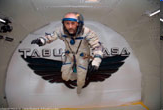
NEW YORK - The next space tourist bound for the International Space Station (ISS) is taking a breather from spaceflight training as he prepares to ride a Russian rocket toward the orbiting laboratory later this year.

American computer game developer Richard Garriott, 46, has returned to the U.S. after an intense six weeks of Russian classes and Soyuz spacecraft training for his planned October flight to the ISS. The one-month rest comes between a series of trips to Russia's cosmonaut training center in Star City, where he and backup Nik Halik have been wading through the intricacies of Soyuz spaceflight.

"In the Soyuz, all of the buttons and things are labeled in Russian, so you need to be able to read and understand a few technical words," Garriott told SPACE.com Friday, adding that he spent four hours each day learning the new language. "There's no question that learning Russian is a little bit of a challenge."

Based in Austin, Texas, Garriott is paying about $30 million to fly to the ISS with two professional astronauts in October under an agreement between Russia's Federal Space Agency and the Virginia-based tourism firm Space Adventures, which brokered the flight. He plans to conduct Earth observations and protein crystal growth experiments during his mission and launched an educational contest for British students to devise their own tests that he could perform.

In between language lessons, Garriott and Halik spent four hours each day studying Soyuz spacecraft training manuals and exploring Russia's Gagarin Cosmonaut Training Center.

"One of the things that I didn't know was there while we were kicking around was that they have a wonderful planetarium," Garriott said, adding that he and Halik hope to visit the planetarium during their next training session. "It's a surprisingly open place."

The two entrepreneurs were careful to keep out of restricted zones and adhere to training protocol. Russian space officials recently replaced South Korea's first astronaut choice, artificial intelligence expert Ko San, for an April 8 launch due to regulation infractions. Ko's backup, female mechanical engineer Yi So-yeon, will take his place during the upcoming spaceflight.

Halik, 38, is an Australian entrepreneur who is paying $3 million to serve as Garriott's backup and experience genuine spaceflight training.

"Though Nik and I had not really known each other before training together in Star City, it turns out we've lived very parallel lives," said Garriott, adding that both he and his backup have taken adventure trips to Antarctica, rode aboard submersibles down to the wreck of the Titanic, experienced weightless on aircraft and flown Russian MiG jets. "Because we have that same adventurous spirit and similar background, training together has been actually really convenient and also given us a well-rounded opportunity to share this experience together."

Garriott developed the Ultima computer game series and co-founded the Origins Systems computer game company as well as the North American branch of the online game developer NCsoft. He hopes to spend his month off from training to catching up with his work. But, Garriott added, he did happen to be in Russia training for spaceflight in early February, when his most recent game "Tabula Rasa" hit stores in Moscow in its Russian packaging.

"Getting a chance to sit down with the players was actually great fun for me and hopefully they enjoyed it as well," Garriott said.

Garriott has expressed an interest in paying an extra $15 million to stage the first spacewalk by a private spaceflyer, though whether the activity could come together in time for his flight is up in the air. He has already been fitted for his Russian Sokol spacesuit, the partial pressure garment that he will wear during launch and landing, but not one worthy of a spacewalk.

"Of course I would love to do it if it could be done," said Garriott, adding that he hopes to put together some sort of simple, feasible science experiment in case it opportunity arises.

Garriott will be the sixth paying visitor to the ISS, but the first American second-generation spaceflyer to reach orbit. His father, Owen Garriott, is a retired NASA astronaut who flew aboard the U.S. Skylab space station and shuttle Columbia, and will serve as chief scientist for the coming spaceflight.

"One of the more interesting aspects of working with my father on this flight is what an appreciation it's given me for the challenges that my dad faced during his time with NASA," the younger Garriott said. "The sense of urgency to get all your ducks in a row and get things lined up appropriately has been high."

Richard Garriott is chronicling his spaceflight training and mission at his personal Web site: www.richardinspace.com.

Wednesday, February 13, 2008

Space flight experience at a bargain price

image

A promotional shot of Virgin Galactic's Spaceship Two.

If a $260,000 flight into space busts your budget then maybe the $23,000 sub-orbital space flight training is more up your alley.

Open to the public for the first time, the simulation has been designed to mimic an intergalactic experience.

Three Australian travel agents have recently returned from the Virgin ASA Global Forum in the US where the Virgin brainchild was launched.

But the ride comes at a cost.

Virgin is planning on putting together half day (about $2030), full day (about $3390) and two-day (about $5645) packages for space junkies.

Edwin Spencer, director of Spencer Travel in Sydney, said that the simulation conveys what a trip in space is like, however the G forces on the ride are a little lower. He thinks that it is worth the cost.

"You get the exact same experience as if you were going to do one of the flights (into space)," Spencer said from the conference in Philadelphia.

"They (Virgin) are trying to promote this facility to give you the experience of what it would be like on a space flight. It's so deadly accurate."

Having said this, Spencer admits that it's not for everyone.

"I think by the time you package it all and you get them over here it's probably going to cost about $20,000, with airfares and accommodation.

"... It's not going to appeal everyone but it's brand spanking new ... it's something really really unique.

"The big boys toys kind of people. The guys that love the adventure."

The travel packages will include the sub-orbital space flight training in Pennsylvania and the longer sessions will also include training on a parabolic flight and fighter pilot training in Las Vegas.

Spencer Travel, accredited as a Virgin Galactic Space Agent, sold Australia's first fully-paid ticket to space last year.

The journey into space takes two and a half hours to fly up 15,240 metres. The mothership then drops the rocket and it is sent soaring to 116,000 metres.

To put it into context, a standard aeroplane flies at about 9000 metres.

Passengers then experience five minutes of weightlessness before being returned to earth.

The $260,000 journey takes just a day but involves two days training.

The first 100 visitors to go into space, deemed Founders by Virgin, are expected to make the trip in 2010. Most positions on the Founders team were invitation only, but one fully-paid female from Australia made the rollcall.

"She is determined to be in the first 100," Spencer said.

The space-loving customer wants to keep a low profile, but Spencer said that she is an adventurer.

He said that space travel hadn't aroused the same excitement here as it had in the US.

"It's not that big in Australia but in the US it's huge," he said.

"This is just the beginning. It's the ultimate experience in life.

"It's that whole concept of being able to see Earth out of the left hand porthole and space from the right hand porthole."

IF YOU GO:

Visit: http://www.spencertravel.com.au

Saturday, February 9, 2008

Kiwi space hopefuls at Virgin Galactic unveiling (+photos)

1

Two New Zealanders who hope to become the first Kiwis in space were in New York last week for the unveiling of Virgin Galactic's launch system.

Christchurch real estate agent Jackie Maw and businessman Mark Rocket, a space enthusiast who changed his name by deed poll, have bought $280,000 tickets on one of British entrepreneur Sir Richard Branson's space journeys, scheduled for late next year or early 2010.

The three-hour trip will take them 112km above the earth.

Established in 2005, Virgin Galactic successfully launched its SpaceShipOne craft into space in 2004, winning the $10m Ansari X prize for the first non-government organisation to launch a reusable manned space craft into space twice within two weeks.

With SpaceShipTwo and its "mothership" launch vehicle, White Knight Two nearing completion at the Scaled Composites plant in California, more than 200 people worldwide have signed up and paid deposits for space trips.

Ms Maw said the seriousness of the project hit home to her at the design unveiling in New York.

2

3

4

"It is not just about sending passengers into space as a commercial venture," she said in a statement today.

"While that is part of it, we are in effect a source of capital which is enabling developments and exploration which will change our world."

Ms Maw, who has already completed an astronaut training course at the National Aerospace Training and Research (Nastar) centre in Philadelphia, said it was "incredibly motivating and exciting" to know those involved were part of that exploration.

Mr Rocket, co-director of Rocket Lab, a company that hopes to put New Zealand's first rocket into space this year, was the first New Zealander to buy a Virgin Galactic ticket.

He classifies himself as a "space industry participant" as well as a Virgin Galactic founding passenger and said he was equally motivated by the unveiling and what it meant long-term.

The first 100 people to sign up and pay for their future flights were invited to the New York unveiling - a media event and cocktail party covered by 30 television channels.

Mr Rocket said while predominantly from the United States and Britain, people were there from all over the world, including small places such as Estonia and Morocco.

Coming from New Zealand "attracted interest, but was not seen as out of the ordinary", he said.

- NZPA


Source: nzherald.co.nz

Tuesday, February 5, 2008

Travel agent books seat into space

image

Travel agent Craig Burkinshaw is booked on a £100,000 trip out of this world.

The businessman, whose Witney company Audley Travel provides tailor-made holidays for anywhere on Earth, is going a little further himself, with a ticket to go into space.

He has paid a fee of $200,000 (£100,000) for Flight 32, seat 190, on Sir Richard Branson's Virgin Galactic, expected to become the world's first commercial spaceline.

Mr Burkinshaw, 37, last week took a training flight in the US to experience weightlessness.

He said: "We had just a short time of floating around, but on the real trip it will be up to five minutes.

"I can't wait, it's extre- mely exciting. I want that feeling again and to look at the Earth out of the window just like the astronauts."

The first commercial flight is now expected to be early in 2010.

Each trip will have six passengers, carried up to about 60,000 metres on an aircraft, when a rocket is released to zoom just beyond 100km, defined as the boundary of space.

The whole flight is expected to last no longer than two-and-a-half hours, costing about £11 a second.

Mr Burkinshaw said he was only too willing to pay.

"It's a lot of money but I want to be among the first," he said. "I've done skydiving many times and travelled all round the globe, but this is going to be fantastic."

And his girlfriend is quite understanding. "She knows I'm into astrophysics and all that sort of thing," he said.

"There's a lot of money going into commercial space travel and there's nothing to worry about."

Sir Richard's Virgin Galactic company unveiled a model of its vessel, SpaceShip Two, this year, and testing is due to start in the summer.

Its first flights are expected early in 2010, with take-off and landing in New Mexico, in the USA.

The first 200 passengers are now signed up to fly.

They have to undergo medical assessments, including whether they can withstand the G-forces of extra terrestrial flight.

An American company, Wyle, whose Life Sciences Group has four decades of supporting the space agency Nasa, has been brought in by Virgin Galactic to provide medical and management expertise to prepare passengers for spaceflight.

The cost of the 150-minute trip is £100,000, but Sir Richard, who has a house in Kidlington, has been quoted as saying it could go down to about £10,000 in a few years. If you fancy booking a flight, call the tour operator Elegant Resorts on 01244 897000.

By David Horne

Friday, February 1, 2008

Cosmic travel set to take off

Testing begins this summer on Virgin's new spaceship with launch expected to be in 2010

Last week, Richard Branson’s Virgin Galactic unveiled a model of SpaceShipTwo, the vehicle he promises will turn space tourism into a reality.

Fancy an out-of-this-world trip? Here’s the lowdown for potential high-flyers.

When can I go? Testing will start this summer. The first passenger flights were expected next year, but Virgin insiders say 2010 is more likely. How’s it done? While conventional rockets blast off from a static position on the ground, SpaceShipTwo will be carried up to 50,000ft by its launch aircraft, WhiteKnightTwo. After release, it engages its rocket engines to power on up to 360,000ft, or 68 miles above sea level, in 90 seconds.

What can I do up there? Float about, mostly. You’re high enough, at the apex of the flight, for the earth’s gravity to be pretty much unnoticeable. The period of weightlessness will be only five minutes or so during the 2½hour trip, but you’ll be encouraged to enjoy it – seatbelts off, and 7ft of headroom to bob about in.

Bad news for anyone wanting to test the carnal possibilities of zero gravity, though. Branson has made cracks about joining the 60-mile-high club, but, with eight aboard (six passengers, two pilots), there won’t be much privacy. There’s no loo to escape to, either – which means “Nasa nappies” may be used to prevent disasters. Hardly sensual.

What will I see? Don’t expect that humbling view of the faraway earth isolated in space that lunar astronauts found so moving – you’d have to go a lot further for that. But you will have a clear sense of the curvature of the globe, and views of 1,000 miles in every direction through the multiple 18in-wide windows.

Initially, that’ll be 1,000 miles of southwest USA – SpaceShipTwo’s Norman Foster-designed spaceport is being built in New Mexico. But Virgin Galactic has firm plans for launches from Sweden, and is in discussion with RAF Lossiemouth, in Scotland. If they go ahead, you’ll be able to fly straight into the northern lights – or take in the whole of the British Isles at a glance.

Who’ll be in the next seat? Stephen Hawking, Victoria Principal, the designer Philippe Starck and the environmentalist James Lovelock are among the 200 signed up to fly.

Do I have to be fit? You’ll have to go through a medical assessment and centrifuge training to see if you can withstand the G-forces. At one point, they’re expected to reach 6 g – “like an elephant sitting on your chest”, according to astronauts.

How safe is it? The maker, Scaled Composites, says that safety is at the heart of the design, and launch will take place only after exhaustive tests and approval by the US Federal Aviation Administration. But going into space is not the same as hopping on a jumbo. The company’s president, Burt Rutan, told reporters at the model’s launch that he was aiming at similar safety levels to the early airliners of the 1920s, rather than today’s standards. “Don’t believe anyone who tells you that a new spacecraft is as safe as a modern airliner,” he said.

What will it cost? You’re looking at about £100,000, though Branson says that the price may come down to as little as £10,000 in a few years. You could always use your air miles: Alan Watts, from Harrow, has paid for his entire ticket using Virgin Atlantic frequent-flyer points. He had 2m of them.

Anyone else doing it? Branson may be ahead, but there are plenty of others in the tourist space race – among them the Amazon.com tycoon Jeff Bezos, Elon Musk, the founder of PayPal, and EADS, the European consortium that owns Airbus. Its suborbital rocket is promised for 2013.

What’s the carbon footprint? It’s not good, but it’s not as colossal as you might think. Virgin Galactic claims that one astronaut’s emissions will be less damaging than those caused by a business-class return to New York – that’s about two tonnes of carbon. It’s looking at biofuel systems to lessen the effect.

How can I book? Direct with Virgin Galactic (www.virgingalactic.com ) or via its UK agent, the posh tour operator Elegant Resorts (01244 897000, www.elegantresorts.co.uk ). Yes, the same people who’ll take you to Sandy Lane.

Can’t I go a bit further? Possibly. The US company Space Adventures – which sent the first space tourist, Dennis Tito, to the Russian Soyuz space station in 2001 – is offering trips to the moon for a cool $100m, and says it could launch within four years of getting its first customer.

Source

Thursday, January 24, 2008

Serge Dive Interviews: Carolyn Wincer, Head of Astronaut Sales, Virgin Galactic


Sir Richard Branson always fantasised about space travel. So when Dr Peter Diamandis dreamt up the $10m (£4.8m) Ansari X-Prize - the inspiration for private space travel - aerospace engineer Burt Rutan, Microsoft co-founder Paul Allen and Branson teamed up. In June 2004, SpaceShipOne successfully completed her first test flight.

- What exactly is the Virgin Galactic experience?

It is a sub-orbital spaceflight which will be available to the paying public. Following astronaut training the space tourists take the SpaceShipTwo flight. The climb up to 50,000ft for the air launch will afford amazing views. After a brief freefall when SpaceShipTwo drops from her mothership, the rocket burn will push them back in their seats as the spacecraft accelerates to supersonic eye-watering speeds within 10 seconds of ignition, then to almost four times the speed of sound in 30 seconds. The sky turns from blue to black as they are propelled almost vertically out of Earth's atmosphere and into space.

The rocket engine will be shut off to reveal instant silence. Astronauts will have 1,000km visibility with the thin blue line of the atmosphere, the blackness of space and the curvature of Earth plain to see, all while floating weightless around the cabin. After a few minutes, they will begin to feel Earth's gravity pulling them back home, peaking at 6 Gs during a carefree and relatively heat-free re-entry. After a 45-minute glide back to the spaceport, they will greet their loved ones and be given their Virgin Galactic astronaut wings. All for just $200,000 (£96,900).

- How have Virgin Galactic sales gone to date?

Since 2005, more than 200 people from 31 countries have paid a deposit, and some 70,000 people from around the world have expressed interest. We also have over 82 'accredited space agents' in 17 countries, currently accounting for 50% of sales.

Tell us about the involvement you have had with Philippe Starck and Stephen Hawking...

Philippe is amazing to work with and we feel incredibly privileged to have his creative input. He provided the inspiration for our brand and ensures all aspects of design maintain brand integrity.

Professor Stephen Hawking has a deep desire to go to space and we hope to help him fulfil that. He has contributed so much to our understanding of the universe and inspired people to look for answers to some of the biggest questions ever asked - namely, how did we get here?

- Is space travel the future of luxury travel?

I think it is the new frontier of luxury travel. Within 10 to 15 years, people will be visiting hotels in orbit, shortly followed by holidays to the moon and hopefully beyond. I hope that in 40 or 50 years' time we will have managed to create a vibrant industry enabling tens of thousands of people to work, live and holiday in space, and one that has made positive contributions to the issues facing our planet.

- Which country will use Virgin Galactic the most?

The US is the most important, with around 50% of sales to date. Thankfully, our price is in US dollars so Americans are still comfortable with buying.

- Which luxury companies do you respect?

I hugely admire Virtuoso. Matthew Upchurch has created a dynamic and innovative organisation. He has unbelievable foresight: about 10 years ago when everyone else was saying that travel agents were a dying breed, he instinctively knew that travellers were always going to need them.

- What mistakes have you learned most from?

Thinking if successful companies do things a certain way there is a good reason for that, and we should do it that way too. It couldn't be further from the truth.

- What is the key driver for luxury travel?

Accessibility. As a destination or experience becomes more accessible, the high end of the market drops it like a hot cake and moves onto something more exclusive, or at the very least, more expensive. Only product innovation, coupled with courage, can keep a company exclusive in the eyes of the luxury traveller.

- What advice would you give the industry?

Define your values as a company. Words like 'honest' and 'exciting' make excellent brand values.

- Serge Dive is one of the three founding members of the International Luxury Travel Market, held in Cannes.

Monday, October 1, 2007

Leads to Space Settlement

Space tourism is a reality. Four tourists have traveled to the International Space Station (ISS) at their own expense and at least four companies are developing sub-orbital tourist vehicles (Virgin Galactic, Space Adventures, Rocketplane Kistler, and Blue Origin). Not only does space tourism extend the freedom to travel into space for those with the means, it promises a profitable market to develop the launch vehicles necessary to expand life throughout the solar system. Space tourism may solve the single most difficult problem holding up space settlement: safe and inexpensive transportation from the surface of the Earth to Low Earth Orbit.

Present launch capabilities, while sufficient for communications, remote sensing, some space science and limited manned operations, are grossly inadequate for large scale space settlement. By space settlement we mean very large numbers of people living in giant orbital spacecraft, on the Moon, on Mars and/or within large asteroids. Space settlement could provides humanity with hundreds of times more living area, thousands of time more physical resources, and millions of times more energy than is presently at our disposal. Such a vast expansion of the resources available to human civilization would eliminate the need, although perhaps not the practice, of resource-driven war. Such warfare kills and maims large numbers of people and destroys their work. Substantially better launch capacity is a necessary precursor to space settlement, but progress over the last 50 years has been disappointing. Space tourism may change that.

Over the last 50 years a wide variety of launchers have been developed, up to and including the U.S. Space Shuttle, the most capable space vehicle to date. However, in spite of decades of development, Earth-to-Orbit transportation costs thousands of dollars per kilogram and suffers a catastrophic failure rate of a one or two percent. Worse, these figures have not improved with time. For example, the Saturn V was developed in the 1960’s to put men on the Moon. This vehicle cost less, measured in man-hours per ton to LEO (Low Earth Orbit), than today’s major launch vehicles. Furthermore, the Saturn never suffered a catastrophic failure, although there were many close calls. By contrast, current shuttle costs run between $500-1,000 million per flight to deliver, at most, a few tens of tons of payload to the International Space Station, and the shuttle has suffered two catastrophic failures in just over a hundred flights.

Aircraft developed much more rapidly in their first 50 years. This may be because hundreds of thousands, if not millions, of flights occurred in that period, but we have only launched a few thousand payloads into space. Substantial launch vehicle improvement may require tens of thousands of launches per year, not the current 50-70. Unfortunately, current markets for space launch: communications, Earth-observing, science, national prestige, etc. cannot support hundreds of launches per year, let alone tens of thousands. However, a new space market has recently been created: Space Adventures, Ltd. and the Russian space program have flown four tourists to the ISS, reputedly for about $20 million apiece. Although the ISS was originally intended to serve a host of space applications, it has not yet done so for a variety of reasons. Space tourism
may be the legacy of the ISS, and it could be a very good one indeed.

The only market for humans-in-space potentially capable of sustaining thousands of flights per year is tourism, if the cost is in the $100,000 range or less. If the price is in the $10,000 range, millions of flights can be supported. Published market research suggests that the space tourism market may become very large if the price is right. In 1994, Patrick Colins, et all found that the Japanese market could provide about one million customers per year for space flight at about $10,000 per passenger. In 1996, Sven Abitzsch found that approximately 20% of the U.S., Canadian and German populations and nearly 40% of the Japanese population would be will to pay over $10,000 (actually, six months salary) for a trip into space. This represents nearly a hundred million people. In 1999, Oily Barrett found that 12% of United Kingdom residents, representing 3.5 million people, said they were willing to pay over $10,000 for a trip to space. In 2001, Crouch surveyed the literature and found that the global space tourism market is a strong function of price, with an annual demand of five million per year at $10,000 per flight and 170 at $500,00 per flight, representing annual markets of $5 billion and $85 million respectively. Table 1 shows Crouch’s demand vs. price per ticket. If these projections are optimistic by no more than a factor of ten, and the price per ticket can be brought down sufficiently, there is good reason to believe space tourism can support tens of thousands of launches per year or more, a rate comparable to the early decades of aviation.

price/ticket (1994 $) passengers/year
$1,000 20 million
$10,000 5 million
$100,000 400 thousand
$250,000 1,000
$500,000 170

All human-capable orbital vehicles to date have been developed as national projects by the U.S., Russia/USSR, and China. For sub-orbital vehicles the picture is quite different. Spurred by the $10 million Ansari X-Prize, a change in the way launch development was rewarded, Scaled Composites, LLC built and flew SpaceShipOne into space twice in as many weeks in 2004. Interestingly, these were the only U.S. manned space flights that year as the Shuttle was grounded after a fatal accident in 2003. While Scaled Composites reportedly spent considerably more than the purse to win, other commercial deals involving advertising and technology sales netted a small profit. As a direct result, Scaled is now developing SpaceShipTwo for Virgin Galactic. Virgin Galactic is building a space port in New Mexico and intends to fly tourists into space for two hundred thousand dollars per trip within a few years. Furthermore, Virgin has serious competitors.

Space tourism may lead to large numbers of people traveling to space in the next few decades. Burt Rutan, the technical genius behind SpaceShipOne, made a prediction in a 2004 talk in San Jose, CA:
Within 5 years 3,000 tourists will have been to space.
Within 15 years sub-orbital tourism will be affordable, and 50,000 people will have flown.
Within 15 years the first, expensive orbital tourist flights will have happened.
Within 25 years orbital tourism will be affordable.

Space settlement has tremendous potential benefits for mankind but requires a much more robust and inexpensive launch capacity than is available today. Traditional approaches to improving launch have failed to deliver a sufficiently capable system over the last few decades and shows little promise of doing so. To address this issue, we propose orienting launch development towards the tourist market, which, at the right price, is large enough to support tens of thousands of flights per year. Just as computers once cost millions of dollars and were only available to the few, space tourism today is the province of the wealthy. However, as the cost of computers plunged, they have become part of everyday life for the world’s middle-class. Space tourism promises to do something similar for personal space flight. Just as one day millions of years ago life, for whatever reason, crawled out of the oceans and onto dry land, space tourism may well begin the spread of life throughout our solar system.
sorce
http://www.nss.org

Tuesday, August 28, 2007

Space tourism tickets to skyrocket

Software billionaire Charles Simonyi, shown here doing a "Superman" act during a zero-gravity airplane flight, took a multimillion-dollar trip to the international space station.

CAPE CANAVERAL, Fla. - When it comes to complaining about poor exchange rates for the U.S. dollar, American tourists traveling to Europe have nothing on tourists headed into space.

The cost of flying to the international space station aboard a Russian Soyuz spaceship has increased from $25 million earlier this year to between $30 million and $40 million for trips planned in 2008 and 2009.

"It's mostly because of the fallen dollar," Eric Anderson, president and chief executive officer of Space Adventures, told The Associated Press on Wednesday. His company brokers the trips with Russia's space agency.

A U.S. dollar currently is worth about 25 1/2 Russian rubles, compared with 32 rubles in 2002.

Five space tourists have paid $20 million to $25 million to visit the space station via the Soyuz vehicles through trips arranged by Space Adventures. The company announced Wednesday that two more Soyuz seats have been purchased for tourists to fly in the fall of 2008 and the spring of 2009.

Anderson said the space tourists flying in the two new seats likely would be an American and an Asian, but he offered no further details on Wednesday.

Space Adventures said the identities of the would-be fliers would be announced sometime in the next few weeks. "We have finalized the contracts with those who will fly on future seats, but we are always willing to speak to multiple individuals for a specific seat and encourage other interested parties to step forward and contact us, because the most willing and committed ultimately gets to go first," Anderson said in Wednesday's written announcement.

In May, Anderson told MSNBC.com that the next space passenger would be an American male. He also said the flight would mark "another first." That was a reference to April's flight of software executive Charles Simonyi, the first billionaire to go into space.

Prospective space tourists must put down a 20 percent deposit, pass physical examinations and later undergo training at a Russian space facility.

About a dozen prospective space tourists are in the process of reserving flights to the space station, even as the number of available seats on the three-man Soyuz vehicles is likely to diminish after space shuttles are grounded in 2010.

Wednesday, July 25, 2007

Three, two, one - Commence bragging!

A quick and easy trip into space may be the next frontier for the been-there-done-that traveller

MATTHEW TREVISAN

From Wednesday's Globe and Mail

July 18, 2007 at 9:18 AM EDT

It took John Criswick less than a week to make his decision. It was something he had always wanted to do, ever since his parents bought him a telescope when he was 10. Never mind that it cost $200,000 to get there. He wanted to bring some adventure back into his life.

He would go to space.

"I like to have a little bit of risk and not be able to predict what's going to happen," said the 43-year-old CEO of Magmic Games, an Ottawa-based company that publishes and develops games for cellphones and BlackBerrys. "It's not just about the launch. A bunch of things are going to happen to me between now and then because of it."

Criswick is one of four Canadians who have signed up for Virgin Galactic's trips to space, slated to start in late 2009 or early 2010. Worldwide, almost 200 people in 30 countries have signed up for the 2½-hour trip to the final frontier.

To promote this nascent industry in Canada, Virgin Galactic has appointed five Canadian travel consultants who will act as sales representatives for the London-based arm of the Virgin Group of companies. Last week, Virgin's head of astronaut sales, Carolyn Wincer, trained the "accredited space agents" in Vancouver and visited them in their respective cities.

"It's a unique product to sell and one that's quite complicated, with a lot of unusual questions and one that not a lot of people know about," she said from the company's Toronto office.

Right now, it seems Virgin will take anyone willing to slap down a $20,000 (all figures U.S.) refundable deposit for the trip. There are no prerequisites other than "good health and reasonable fitness."

"The problem is that until now, nobody's monitored normal, everyday people undergoing G-forces," Wincer said. "The only people that are monitored are people training to be fighter pilots, and they are already trained to be in peak condition.

"So we hope to know more very soon ... but having said that, the G-force profile is nowhere near what fighter pilots and astronauts going to the moon have had to undergo. It should be fairly okay."

Travellers will experience a maximum of 3.5 Gs during their brief sojourn to space, Wincer said. Fighter pilots regularly experience about nine Gs, and even intense roller coasters can generate five.

This fall, Virgin will be sending the first 100 customers to human centrifuge training in Philadelphia, where specialists will test their ability to withstand G-force pressures, which can cause blackouts and even redouts, in which capillaries in the eyes burst.

"After those first 100, the goal is that they can just turn up a few days before a flight and do it," Wincer said.

Make space travel simple: That's what British billionaire Richard Branson, the Virgin Group's founder, had in mind when he partnered with Burt Rutan, the aerospace engineer who designed the company's spacecraft, SpaceShipOne.

The vehicle was the winner of the $10-million Ansari X Prize, a competition for the first reusable, non-government, manned spacecraft.

Virgin will take its travellers on a brief, sub-orbital flight that reaches its peak 110 kilometres above Earth. They won't go fast enough to go into orbit, so the trip is essentially like throwing a gigantic ball into a parabolic arc and having it float safely to the ground.

The travellers will undergo a medical assessment six months before their flight. Wincer said they fly at their own risk and go through a process of "informed consent" before signing a waiver.

"At each stage, we advise what we know and what we don't know, and likewise the passenger has to advise the same thing," she said.

After two days of psychological, safety and G-force training, a mother ship will take the travellers' spaceship on a 40-minute flight to an altitude of 15,240 metres (the cruising altitude of the now-retired Concorde jet) and then release it.

The spaceship, full of viewing windows, will freefall for a few seconds before firing its rockets, which will propel it to more than 1,600 kilometres an hour and out of the atmosphere.

Once the rockets shut off, the spaceship will reach its maximum altitude, at which point the passengers will experience as much as five minutes of weightlessness.

From there, the spaceship begins a 90-second re-entry phase, creating drag in an effort to re-enter the atmosphere more slowly than a regular rocket. After re-entry, it will take 45 minutes to glide down from 21,300 metres.

Once the tourist flights begin, Virgin Galactic hopes to operate one flight daily. The company will have a fleet of five spaceships and two mother ships. Each spaceship holds six passengers and two pilots, and the entire fleet will cost $20-million.

Wincer says the extravagant cost will come down as more companies start to send tourists into space.

(European firm Astrium recently announced it wants to build a rocket-powered craft to send tourists to an altitude of 100 kilometres by 2012 for about $268,000.)

And, she adds, Virgin's price is a bargain compared with the $20-million that Space Adventures Ltd. charged travellers to join a Russian flight to the International Space Station 400 kilometres above Earth.

To finance his trip, Criswick will use the fortune he made in 1998 when Sun Microsystems bought his company, Beduin Communications, which designed software for consumer electronics.

For those who think they've seen it all, Wincer says, space travel is something genuinely new.

"These days travel is so easy and accessible. Even if you don't have that much money you can often have travel experiences. So to some people, particularly those with money, it's all a bit mundane."

For his part, Criswick has had some experience with the space industry.

The Vancouver native worked as a software developer on a telescope that was eventually launched in 1991 aboard a U.S. spacecraft. That research led to a master's degree at York University. He tried out for the second Canadian astronaut competition but didn't make it because, he jokes, "I didn't have enough PhDs." And he attended a summer session at the International Space University in 1991, where he met some friends who joined him in June 2004 to watch Mike Melvill fly SpaceShipOne over California's Mojave Desert.

He likes to call his trip a path of self-discovery.

"I'm not excited because it's so far away. But I'm sure two or three months before [the trip] my level of anxiety and excitement is definitely going to change."

Wincer adds that anyone who has been to space has returned "almost certainly a confirmed environmentalist" because of the view of Earth and its atmosphere.

"And because we're taking some of the richest people in the world up, who are also some of the most powerful people, we think that might have some positive effects for our planet."

For more information about Virgin Galactic's space flights, visit virgingalactic.com; to book a seat, visit http://www.virtuoso.com.