Showing posts with label ISS. Show all posts

Sunday, April 13, 2008

Entrepreneur talks space travel
image

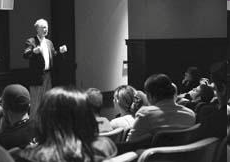
Greg Olsen, scientist, businessman and astronaut, came to the College on March 26 to tell his story in the New Library Auditorium.

Olsen nearly flunked out of high school, failing trigonometry and graduating with an overall average of 70. Coaxed into college, Olsen received his Bachelor of Science in electrical engineering and a master's degree in physics from Fairleigh Dickinson University. A doctorate in materials science from the University of Virginia followed afterwards.

From 1972-1983, Olsen worked as a research scientist for RCA labs. It was here where he got the idea to start his first company, Epitaxx.

"I had no background in business … until 1983 when I got the idea to start this tech company," Olsen said.

With $1.5 million in startup funds, the company focused on making fiber-optic detectors and soon employed up to 55 people and made $5 million a year. The company was bought out by Japanese company Nippon Sheet Glass for $12 million in 1990.

"In 1990 everybody thought Japan was going to rule the world economically," Olsen said. "We all hear about India and China now … Anybody who thinks the U.S. is gonna get left in the dust, just remember what happened in 1990."

Olsen started his second company, called Sensors Unlimited, in 1992. Sensors Unlimited was sold for $600 million in 2000 but Olsen bought the company back a year later for $6 million and later re-sold it for $60 million in 2003.

It was in June of that year that Olsen got the idea to travel into space.

"The inspiration to go to the International Space Station (ISS) came from this," Olsen said, holding up his coffee cup. "Every morning you can find me at the Starbucks on Nassau Street (in Princeton) reading the paper."

It was a chance reading during one particular Starbucks trip that introduced Olsen to Dennis Tito and Mark Shuttleworth, the first two private citizens to board the ISS.

"Have you ever had that feeling where you've seen something and you said to yourself, 'I have to do this?'" Olsen asked.

By April of 2004 Olsen was in Russia training for his spaceflight. In June of that year he was disqualified for having a black spot on his lung.

"That was a devastating experience for me," Olsen said.

He got clearance from American doctors, and pressed the issue with the Russian doctors until he was allowed back into the program in May 2005.

"By February I didn't think that I would get to fly into space, but I just kept at it," Olsen said.

In October of that year, he and two other astronauts launched from Russia.

Olsen showed videos of his trip on the ISS with instructions on how to drink water and eat food. He also demonstrated basic properties of physics using a floating notebook.

Of his experience, Olsen said he was happy with how everything turned out.

"I don't consider myself an astronaut, but I feel like I was properly trained," he said.

Currently, Olsen is the chief executive officer of GHO Ventures and, in addition to managing a winery in South Africa and a ranch in Montana, he funds "Angel Projects," which are startup companies that he believes show promise.

"I love startups," Olsen said. "I thought, why don't I try investing in others?"

By Cameron Prince

Tuesday, April 8, 2008

Next Space Tourist Takes Break from Spaceflight Training

By Tariq Malik

NEW YORK - The next space tourist bound for the International Space Station (ISS) is taking a breather from spaceflight training as he prepares to ride a Russian rocket toward the orbiting laboratory later this year.

American computer game developer Richard Garriott, 46, has returned to the U.S. after an intense six weeks of Russian classes and Soyuz spacecraft training for his planned October flight to the ISS. The one-month rest comes between a series of trips to Russia's cosmonaut training center in Star City, where he and backup Nik Halik have been wading through the intricacies of Soyuz spaceflight.

"In the Soyuz, all of the buttons and things are labeled in Russian, so you need to be able to read and understand a few technical words," Garriott told SPACE.com Friday, adding that he spent four hours each day learning the new language. "There's no question that learning Russian is a little bit of a challenge."

Based in Austin, Texas, Garriott is paying about $30 million to fly to the ISS with two professional astronauts in October under an agreement between Russia's Federal Space Agency and the Virginia-based tourism firm Space Adventures, which brokered the flight. He plans to conduct Earth observations and protein crystal growth experiments during his mission and launched an educational contest for British students to devise their own tests that he could perform.

In between language lessons, Garriott and Halik spent four hours each day studying Soyuz spacecraft training manuals and exploring Russia's Gagarin Cosmonaut Training Center.

"One of the things that I didn't know was there while we were kicking around was that they have a wonderful planetarium," Garriott said, adding that he and Halik hope to visit the planetarium during their next training session. "It's a surprisingly open place."

The two entrepreneurs were careful to keep out of restricted zones and adhere to training protocol. Russian space officials recently replaced South Korea's first astronaut choice, artificial intelligence expert Ko San, for an April 8 launch due to regulation infractions. Ko's backup, female mechanical engineer Yi So-yeon, will take his place during the upcoming spaceflight.

Halik, 38, is an Australian entrepreneur who is paying $3 million to serve as Garriott's backup and experience genuine spaceflight training.

"Though Nik and I had not really known each other before training together in Star City, it turns out we've lived very parallel lives," said Garriott, adding that both he and his backup have taken adventure trips to Antarctica, rode aboard submersibles down to the wreck of the Titanic, experienced weightless on aircraft and flown Russian MiG jets. "Because we have that same adventurous spirit and similar background, training together has been actually really convenient and also given us a well-rounded opportunity to share this experience together."

Garriott developed the Ultima computer game series and co-founded the Origins Systems computer game company as well as the North American branch of the online game developer NCsoft. He hopes to spend his month off from training to catching up with his work. But, Garriott added, he did happen to be in Russia training for spaceflight in early February, when his most recent game "Tabula Rasa" hit stores in Moscow in its Russian packaging.

"Getting a chance to sit down with the players was actually great fun for me and hopefully they enjoyed it as well," Garriott said.

Garriott has expressed an interest in paying an extra $15 million to stage the first spacewalk by a private spaceflyer, though whether the activity could come together in time for his flight is up in the air. He has already been fitted for his Russian Sokol spacesuit, the partial pressure garment that he will wear during launch and landing, but not one worthy of a spacewalk.

"Of course I would love to do it if it could be done," said Garriott, adding that he hopes to put together some sort of simple, feasible science experiment in case it opportunity arises.

Garriott will be the sixth paying visitor to the ISS, but the first American second-generation spaceflyer to reach orbit. His father, Owen Garriott, is a retired NASA astronaut who flew aboard the U.S. Skylab space station and shuttle Columbia, and will serve as chief scientist for the coming spaceflight.

"One of the more interesting aspects of working with my father on this flight is what an appreciation it's given me for the challenges that my dad faced during his time with NASA," the younger Garriott said. "The sense of urgency to get all your ducks in a row and get things lined up appropriately has been high."

Richard Garriott is chronicling his spaceflight training and mission at his personal Web site: www.richardinspace.com.