Showing posts with label Spaceship Two. Show all posts

Saturday, May 3, 2008

Dubai firm becomes first to charter space flight

An unnamed Dubai-based company has become the first in the world to charter a space flight for its top management.

'I cannot reveal any details about the company or the deal, other than (saying that) the flight they chartered can take up to six passengers but they might end up flying only two people,' The National newspaper quoted Sharon Garrett, the head of space marketing and public relations at Virgin Galactic's Dubai office, as saying.

She said the company deposited 1.8 million dirhams ($500,000) last week to charter one of Virgin's commercial aircraft

A part of Sir Richard Branson's Virgin Group, Virgin Galactic is offering sub-orbital space flights and, in the future, orbital space flights to the paying public.

Virgin Galactic's mission is to fly passengers who are not professional astronauts to an altitude slightly over 100 km and allow them to experience weightlessness.

The first flight is planned for 2009.

According to the newspaper, the two-and-a-half-hour trip, on SpaceShipTwo, as booked by the company, will take off from the Mohave Desert Spaceport in California.

The spaceship will be attached to a base ship known as WhiteKnightTwo, which, after a runway take-off, will reach an altitude of 15,240 metres.

At that point, the SpaceShipTwo will be released and its own rocket will blast it to 4,000 kmph, three times the speed of sound, to reach 109,728 metres.

Once in space the passengers will be allowed out of their seats for four minutes to float around in zero gravity.

After seven minutes in space, the craft will return to earth, using a wing feathering technology, which will help reduce the intense heat generated by re-entering the atmosphere, before making a runway landing.

source

Monday, March 31, 2008

Explorer Anousheh Ansari brought space down to Earth


She is the first to sniff space and declare that it smelt like a burnt almond cookie.

In September, 2006, Anousheh Ansari became the world's first private female explorer and, without realizing it, the voice of the quotidian observer of the unknown.

She brought space down to Earth.

The first Iranian-born person in space described the difficulty of washing her hair in zero gravity and of her "internal organs doing a cha-cha inside my belly" when the Russian space capsule, Soyuz TMA-9, started its orbit of Earth before docking for an eight-day visit to the International Space Station.


"What happened with my blog and all the attention I was getting was unexpected," she says during a recent visit to the Ontario Science Centre in Toronto. The daily blog, the first to be written from space, received more than 50 million hits and elicited comments from people around the world.

"A lot of people saw hope," she says. "They were looking at me as one of the most unlikely candidates to be able to do something like this."

In fact, her journey into space is less impressive than the one that got her to the launch pad.

Five years after the Iranian revolution in 1979, she and her younger sister immigrated to the United States with their parents, who wanted their children to get a good education. When they arrived, they lived with an aunt for several months. They were not a wealthy family. "When we left, we basically left with nothing," she says. "We just packed our bags and came."

The transition to American life was not easy. A teenager of 17, she didn't speak a word of English. "Teenagers are a species all by themselves," she says. "They can be cruel, not warm and welcoming at times. I was just in high school to study. I just went to classes and did what I had to do."

She even had to shelve the idea of becoming an astronaut, which had been a dream from childhood. "When I came here, I thought to myself, 'I can be an astronaut now. I'm in America.' That's what I wanted to do - study astrophysics and become an astronaut ... [but] I wasn't a U.S. citizen and I figured, 'Well, what are my chances of becoming an astronaut?' I knew it was not very high, and I knew I had to study something so that I could get a job immediately out of college to support myself and help my family."

So she completed a degree in electrical and computer engineering followed by a master's in electrical engineering. "I had read that electrical engineering and telecommunications, especially, were a grow- ing field," she offers with a shrug in her finely tailored clothing.

In the early 1990s, she persuaded her husband, Hamid, and her brother-in-law, Amir, to help her start Telecom Technologies with their combined savings.

In 2001, the company was bought by Sonus Networks for about half a billion dollars.

Ms. Ansari had still not lost her passion for space. "When we had employee meetings, I would make all my managers dress up in Star Wars costumes, and they would enter the room with Star Wars music playing," she says with only a suggestion of a smile breaking her serious composure.

It was a meeting with Peter Diamandis, chairman and founder of the X Prize Foundation, a non-profit educational organization, that would lead to her space travel. Mr. Diamandis was seeking funding for a competition that encouraged entrepreneurial initiatives to build the first non-government piloted spacecraft. He had heard of her fascination with space.

Ms. Ansari and her family decided to be title sponsors with a donation of $10-million (U.S.). Subsequently renamed the Ansari X Prize, the money was awarded in 2004 to Microsoft co-founder Paul Allen and well-known aviation designer Burt Rutan for their Space-

ShipOne.

The family also announced a partnership with Space Adventures Ltd. and the Russian Federal Space Agency to create commercial space vehicles. To understand the training required for space travel, and as a back-up to a civilian adventurer who was scheduled to fly, Ms. Ansari spent six months at Star City, the Russian cosmonaut facility outside Moscow. Already fluent in English, French and her native tongue, Farsi, she had to learn Russian. "Only three weeks before the flight, they told me that the person who was supposed

to fly failed his medical exam, and I had the opportunity

to do it. It was a complete

surprise."

The flight cost her $20-million. "The most memorable moment was when I first saw Earth from Soyuz. It was very emotional. I was crying," she says. "It was beautiful, an amazing image. It has been a year and a half, and I can see it, still, when I am telling you about it. There's almost a warmth coming from Earth. It is sort of glowing, and it's surrounded by darkness. It gives you a certain energy. You can feel that it is alive."

Since her return to Earth, Ms. Ansari has continued her upward trajectory with a guest appearance on Oprah Winfrey's television show and other talk shows, frequent invitations to speak and a memoir under way.

Commercial space travel will have a profound effect on the way people see the planet, she says. "When you're up there, you do look at the world differently. You do see a lot of possibilities for people working together. You see it as one. You're not looking at your country or your hometown. You're looking at Earth."

In 2006, with her family, she started another company, Prodea Systems, which is developing products for "the digital home" that would integrate services through the television, as one example. "The goal is that new technologies and services would be accessible to everyone, regardless of their technological savvy," she explains.

While her motive is entrepreneurial, it is more social than economic, she says. "Technology doesn't recognize any difference in race or religion or age ... and it has made us closer. It has cut through language barriers and distances."

Her schedule is hectic, the 41-year-old admits. "I spend 10 or 12 hours in the office working, and I think, 'Why am I doing this?' And I remember that I am here for a reason. I have a purpose. ...

"I think that 20 or 30 years from now, people will look back at this time as a great era of evolution for our species."

SARAH HAMPSON

Source
Friday, March 28, 2008

Space planes 'to meet big demand'

image

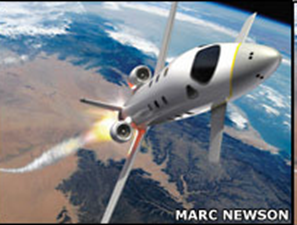
Aerospace giant EADS says it will need a production line of rocket planes to satisfy the space tourism market.

The European company's Astrium division, makers of the Ariane rocket, has plans for a commercial vehicle to take ticketed passengers above 100km.

Its market assessment suggests there could be 15,000 people a year prepared to part with substantial sums of money for the ride of a lifetime.

Astrium anticipates it be will be producing about 10 planes a year.

"To satisfy the market you will need more planes than you think, because once there is regular operation, the price will decrease which means there will be more customers," Robert Laine, chief technical officer (CTO) of the pan-European company, told BBC News.

image

"It will develop towards a classical aeronautical business model. Someone will build the planes; somebody will operate them; somebody will sell the tickets; somebody will provide the accommodation - like any tourism."

The first tickets will retail in the region of 150,000-200,000 euros (£115,000-160,000).

Mr Laine was speaking in London at the Institution of Engineering and Technology, where he was delivering the 99th Kelvin Lecture.

Astrium does not intend to run a space tourism marketing operation itself. Rather, it intends simply to supply vehicles to those who will.

And although production numbers will not be in the same league as, say, Airbus or Boeing, they will be significant nonetheless.

Mr Laine said development of Astrium's rocket plane was proceeding apace.

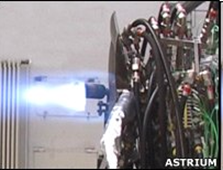
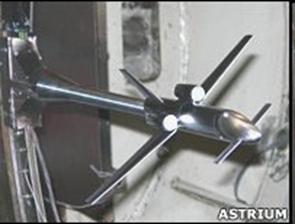
Wind tunnel testing has proven the aerodynamic shape; and the vehicle's Romeo rocket engine which will take the plane above 100km has been ignited for burns that have run up to 31 seconds.

The engine will be using the combustion of a liquid oxygen-methane propellant to provide the more than 1km/s punch needed to break through the top of the Earth's atmosphere.

About 50% of the mass of the plane at take-off would be fuel.

The intention is to produce a vehicle that seats five individuals - one pilot and four passengers.

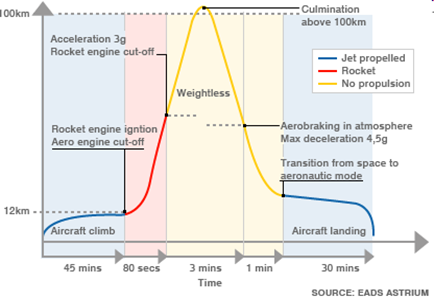
The production model will use normal jet engines to take off and climb to 12km.

From there, the rocket engine will kick the vehicle straight up, taking it beyond 60km in just 80 seconds. By the time the rocket shuts down, the craft should have sufficient velocity to carry it above 100km - into space.

image

As the plane then begins to fall back to Earth, the pilot will use small thrusters to control its attitude, keeping the plane's belly flat to the Earth.

"If you enter with the belly flat down then you expose a very large radius to the aerodynamic flux and that contains the temperature to an acceptable limit," explained Mr Laine.

"We calculate the temperature will be less than 100C on the surface of the wings."

When the plane slows to subsonic speed in the atmosphere, it will use its jet engines again to return to the airport.

image

The total journey time will be about one-and-a-half hours.

Mr Laine said the planes would have about a 10-year lifetime. They would be designed for ease of maintenance, with an operational schedule of one flight per week.

Although the rocket planes could take off and land from any airport, Astrium believes it is likely that special spaceports - possibly 10 worldwide - will operate in a few, restricted locations.

Northern Europe probably would not host one of these, Mr Laine speculated, because of the high density of other air traffic and because cloud would too frequently obscure the view of Earth.

"In Europe, I'd say the most likely location is around the Mediterranean. Why? Because there are blue skies most of the time, and because from 100km you can see mountains, the sea and the coast."

Cheaper space

The Astrium CTO acknowledged that Virgin Group boss Sir Richard Branson would be first into the market with rocket planes based on the award-winning and record-breaking SpaceShipOne concept.

But Mr Laine was confident an Astrium-fed business would be second, with a commercial service that began exactly five years after the agreement of a one-billion-euro financing deal.

He even hoped Sir Richard would be an Astrium customer - just as his airline business is a customer of the EADS Airbus division.

The CTO would not say how soon the initial financing would be in place, or reveal details about the identities of parties that were in discussion.


Long-term, Mr Laine said, space tourism had a major role to play in reducing the overall cost of space access.

He sees rocket planes being used for homeland security purposes as "quick satellites"; and as forerunners of superfast intercontinental passenger transporters.

"Today we don't know how to go to space cheaply. Being able to climb on a regular basis to 100km will give us the motivation to develop the plane that goes, not just up and down to the same place, but from here to the other side of the Earth.

"When the Ariane 5 takes off, 15 minutes later it is over Europe; and 45 minutes later it is over the Pacific. The fastest way is to go outside the atmosphere and that will be the future."

BBC

Sunday, March 16, 2008

You may now float about the cabin


'SPACE: The final frontier, to seek out new life and civilisations." So said Captain James T. Kirk of the Starship Enterprise as he surveyed the expanding cosmos.

But exploration, discovery and adventure are not the sole domain of science fiction: they have always been defining elements of the human psyche.

Once mankind satisfied the lesser, more fundamental requirements such as food, shelter and community, we looked beyond the horizon and wondered, "What if?"

Sure, it took thousands of years for our sluggish and humble species to progress from canoes to steamships, yet much less than one hundred to go from powered flight to space travel.

From a traveller's perspective, now is the most exciting time in our species' existence.

Such have been the astounding technological advances that, in one lifetime, man has flown to the moon and now transverses every continent at an altitude of 30,000ft in the company of hundreds of others, enjoying the latest movies and gourmet meals in pressurised comfort. To many, it's even mundane.

Space travel fell somewhat flat after the Apollo program. Many pundits, such as sci-fi writer Arthur C. Clarke, predicted we'd be sticking flags in Mars and holidaying on the moon by now.

Somewhere along the way we were sidetracked – probably because our expensive, clumsy rockets weren't as reliable as we'd hoped. This is World War II technology, after all.

Riding what amounts to a ballistic missile still hasn't deterred some, despite a pricetag equivalent to the GDP of a small African republic.

At time of writing, there have been five "spaceflight participants" aboard the Russian Soyuz craft, each traveller paying a reported $20 million for the week-long joy ride to the International Space Station (ISS).

Tickets are now being sold for a planned flight to orbit the moon. Price? $100 million each.

Affordable space flight? Enter the X PRIZE Foundation, a non-profit body offering multi-million dollar awards for technological breakthroughs. The 2004 Ansari X PRIZE was won by famed aerospace designer Burt Rutan and financier Paul Allen, who led the first private team to build and launch a spacecraft capable of carrying three people 100km above the Earth. Pounced upon by Virgin supremo Sir Richard Branson, commercial flights are now tantalisingly close.

Branson's Virgin Galactic spaceline expects to launch about 500 passengers annually.

His proposed fleet of five spaceships will have a crew of two and just six passengers, paying US$200,000 ($215,000) each, flying to an altitude of about 110km – the very edge of space – to experience almost 10 minutes of weightlessness.

Unlike NASA's Space Shuttle, which uses huge and dangerous solid fuel rocket boosters, Virgin Galactic's SpaceShipTwo will launch from a jet-powered mother ship called WhiteKnightTwo, and use a single hybrid rocket motor to reach its peak sub-orbital altitude. And because the craft will only travel at around 4000km/h, it will not require heatshields for re-entry.

Branson appointed "space agents" last year, and Gil McLachlan of Harvey World Travel in Manly is one.

"There are at least 10 Australians fully paid up for the flight," said Mr McLachlan, "and there will be more in the next 12 months, for sure."

One such passenger eagerly awaiting his moment on the launch pad is Wilson da Silva, editor of Australian science magazine Cosmos, whose ticket was one of four bought by Dr Alan Finkel, the publication's chairman.

"Hard to believe that it's really going to happen," says da Silva with obvious delight. "It's been a dream of mine since I was a kid."

In Clarke's seminal 1968 work 2001: A Space Odyssey, Dr Heywood Floyd settles into the Orbiter Hilton for a family video call at a rather clunky terminal.

The choice of the Hilton name for that movie was no coincidence; it was a carefully engineered piece of product placement. William Barron Hilton I, the hotelier and grandfather of the famous Hilton sisters, bravely predicted in 1967: "When space scientists make it physically feasible to establish hotels in space and to transport people, the hotel industry will meet the challenge."

Beyond an orbiting hotel, his plans extended to the Lunar Hilton. "To start, we'll have only three floors, which will eliminate elevators and minimise power requirements," he said.

"The multi-storied underground hotel will come later.

"But – and this is very important – in almost every respect the Lunar Hilton will be physically like an Earth Hilton."

But Hilton appears to have lost the inside running to Branson and Robert T. Bigelow, a rival hotelier who is now an aerospace magnate. His Genesis modules are already in space, testing the concept of inflatable habitats for possible "hotel" adaptation.

For most of us reading this far, the reality of space flight will remain a fantasy, experienced vicariously in the Sensurround stadium of the cinema.

But the excitement of weightlessness can be achieved at Kennedy Space Centre, in Florida, on a Zero Gravity flight aboard G-Force One, the plane used to train NASA astronauts and film star Tom Hanks for Apollo 13. For $3500, you even get a DVD of your flight. I predict, however, that theme park, holodeck-style virtual reality will cater for the masses long before actual space flight does.

After all, it was to such a synthetic environment that Star Trek creator Gene Roddenberry's homesick space adventurers went to "get away from it all".

As for the visionary Roddenberry ... his one-way trip into space was in an urn.

The Sunday Telegraph

Saturday, March 8, 2008

XTRAORDINARY ADVENTURES ANNOUNCES 'WORLD'S FIRST SPACE CRUISE' WEEK...

SPACE CRUISE PLANNED IN APRIL 2009... XTRAORDINARY ADVENTURES is bringing a few famous astronauts aboard the yacht Sea Dream to select several passengers for a future sub-orbital spaceflight. Participants will experience weightlessness on a Zero-G flight from the Kennedy Space Center and G forces during space training.

A Florida company is bringing several U S Hall of Fame Astronauts on the luxury yacht Sea Dream to select future sub-orbital space participants during their 'Space Cruise' week event in April 2009. According to Mitchell J Schultz, it's Director, “ninety-six possible participants from around the globe are expected to register and become a part of space history.”

As the opportunity for commercial human spaceflight approaches, XTRAORDINARY ADVENTURES will enable a number of their participants to be selected and take part in this newest advent of excitement and exploration for man......by becoming a passenger on a future sub-orbital spaceflight.

Schultz further elaborates “with chances no greater than one out of sixteen and with a week full of stimulating space related events, participants will thrill to the experience of a lifetime as they schmooze with others of similar interests and mingle with U S Hall of Fame Astronauts that are all part of the festivities.”

In addition, XTRAORDINARY ADVENTURES will bring participants to Kennedy Space Center for a variety of special events including a chartered Zero-G flight, where each person will receive a personalized flight suit along with photos and a DVD of their experience. Participants will also receive a special two day space training program at NASTAR, near Philadelphia, where NASA has trained several Astronauts.

Ever since the dawn of early human spaceflight in the 1960's, mans desire to experience the awe of space, weightlessness and feel the power of  rockets and G  forces has excited many to wonder if and when will this opportunity be within reach. Now, it appears that the time is almost at hand with the successful flight of SpaceShipOne in October 2004 and entering the world into a  commercial sub-orbital space race.

With costs ranging from $98,000 to $250,000 for a seat, XTRAORDINARY ADVENTURES has put together a program for $35,000 that Schultz claims “will allow all our participants an opportunity to not only taste the flavors of a space trip, with their space training and weightless flight experience, but will also send up to six lucky participants on a future sub-orbital spaceflight with an authorized FAA licensed carrier or provide for a payment of $150,000 to each of the six if there are no scheduled flights or departures by April 30, 2012.” 

Mitchell J Schultz is an experienced adventurer, world traveler and avid space enthusiast. Traveling for over 40 years, he has visited over 50 countries and has founded XTRAORDINARY ADVENTURES, LLC to market the making of 'Dreams to Reality' for the true space adventurer. Discriminating travelers with the inclination and the budget to take the space cruise will participate in the world's most exhilarating week of space related events and activities culminating with sending participants on a future sub-orbital spaceflight that will forever become one of their most memorable experiences.

For more information visit www.XtraOrdinaryAdventures.com

Tuesday, March 4, 2008

The Stars: Our Destination

Vacations in space and time

Forty years ago it was “one small step for man, one giant leap for mankind.” Now it is a small step for anyone who dares.
For the last four decades, space flight has been neglected as a primary conduit to human evolution. Popular opinion sees space flight as a sidebar to human development. Even NASA, with their use of aging, decrepit and obsolete shuttles, appears to believe the same. But fear not, for our savior has arrived in the form of a virgin. Well, the Virgin Galactic program that is. Virgin has taken the initiative in commercializing space

Image courtesy of virgin galactic, design by sky 26
travel as a luxury for those who can afford it

image

The dream of everyday space flight has been around a long time. But, while science fiction has been escalating in the last decade with advanced computer-generated graphics, society has largely forgotten actual space exploration. In the mid-20th century, the United States and the former Soviet Union were feverishly involved in pushing space exploration. It seemed that, like in Star Trek, space exploration was best executed by the government.
In the 1980s, NASA began to launch shuttles that took off from and landed on Earth more than once. These shuttles cut down on the cost of development. The down side of the shuttle, however, was they offered no progression. The need to develop new models was minimal.
Since then, however, the idea of international cooperation has inspired multiple governments to join together and build the International Space Station. Bent on scientific discovery rather than territorial expansion, the station has ended much of the exploration being done by governments. The weight of exploration is now left to the private sector. With little room being left on Earth to expand empires, corporations like Virgin have seized the opportunity to expand their market into space. It offers free expansion as no one currently owns space.
Further initiative came from the Ansari X prize. It inspired innovators and dreamers to build the first commercial sub-orbital space craft. Many competitors strove to reach the goal and win the prize: $10 million. It was a company named Scaled Composites, founded by Burt Rutan, that eventually designed the winner. Named SpaceShipOne, it flew at an altitude of more than 100 kilometres. The design of SpaceShipOne is simple and efficient, which makes it significantly less expensive than NASA’s fuel-guzzling shuttles.
SpaceShipOne uses a form of biofuel. The fuel is practical enough to allow the ship to reach sub-orbit, but requires less than half of what a normal shuttle does. To achieve optimal efficiency, Scaled Composites attached the SpaceShipOne to WhiteKnightOne, an aircraft. Instead of launching from the ground, ShipShipOne launches after becoming airborne. This technique allows for even more efficiency.
The ship’s efficiency was what drew Virgin’s Sir Richard Branson. The company was inspired to begin its own attempts at building a commercially viable passenger space craft. Based on the SpaceShipOne’s design, SpaceShipTwo has become Virgin Galactic’s platform for allowing private citizens to visit space.
“It was Stephen Hawking who first got me thinking about this issue when he explained clearly and concisely to the BBC that mankind had no option but to get to space as quickly as possible and start doing things up there that we have been doing on planet Earth, but in a much more efficient manner,” Branson said at SpaceShipTwo’s unveiling.
Branson seemed sincere when he said that space flight is essential to human development. Without prospects of commercial success, however, Virgin Galactic would be unable to justify their investment to stockholders.
That profit requirement means a ticket to space does not come cheap. Current pricing places the cost of a ticket at $200,000 US a seat. The ticket will buy tourists a several minute journey at sub-orbital altitudes.
Though the initial price of a ticket will prove far out of reach for most consumers, it is expected to incrementally decrease as the program continues to pick up speed. After a few years and a few hundred people, the price of a ticket will most likely go down to $20,000 US a piece.
There are others, however, who are finding a way around paying the hefty fee. A British businessman was able to exchange two million Air Miles points for a ticket aboard one of the first flights. However, for the majority of people, $20,000 is far too expensive, even if it is to witness something as spectacular as seeing planet Earth from space. 
Yet Branson sees this as just the beginning of better things to come for the industry.
“With the end of the oil era approaching and climate change progressing faster than most models have been predicting, the utilization of space is essential not only for communications but also for the logistics of survival through things such as weather satellites, agricultural monitoring, GPS and climate science.”
Not only would space be a reasonable way to guarantee survival of the species, it would also guarantee optimal profit should Virgin Galactic hold a monopoly on commercial space flight. However, without a profit, there would be no motivation for space tourism in the first place.
Several companies, such as Rocketplane Limited, Space Adventures and EADS Astrium, have announced their intention to be commercial spaceflight agencies. There is no doubt that in the future, spaceflight will become a standard of travel.
For Virgin Galactic, however, tourism is just the beginning. The company will most likely expand from tourism to a more lucrative industry like transportation from one side of the Earth to the other. Instead of taking a day to travel to Japan, a spaceship capable of holding up to 100 passengers could cut that time significantly.
The advantages of commercial space flight are numerous. Its ability to push innovation is already taking the place of NASA. Government will always play a role to some degree, but ventures such as asteroid mining, solar energy collectors and colonization will be ideal for corporations to invest their time and money into because of the potential for maximum profit.
Although governments could plan and build environments on other planets to house humans, it would be capitalism that forces the economy and infrastructure. What drives people to exotic places is not just a sense of adventure but, like with any new frontier, the possibility of discovering a better life with better job opportunities. Those jobs will be provided by companies like Virgin.
Relatively speaking, there are still more than enough complications prolonging spaceflight developments. While interplanetary exploration is accepted as a future prospect for mankind, interstellar spaceflight is a bit more complicated with the vast gaps between stars. It would currently take centuries to get to the nearest star systems using the most powerful propulsion methods currently available. Though most of us will not be able to see the interstellar steps, we will be alive to see the first true steps of space exploration.


Written by Brent Rose, Contributor

Wednesday, February 13, 2008

Space flight experience at a bargain price

image

A promotional shot of Virgin Galactic's Spaceship Two.

If a $260,000 flight into space busts your budget then maybe the $23,000 sub-orbital space flight training is more up your alley.

Open to the public for the first time, the simulation has been designed to mimic an intergalactic experience.

Three Australian travel agents have recently returned from the Virgin ASA Global Forum in the US where the Virgin brainchild was launched.

But the ride comes at a cost.

Virgin is planning on putting together half day (about $2030), full day (about $3390) and two-day (about $5645) packages for space junkies.

Edwin Spencer, director of Spencer Travel in Sydney, said that the simulation conveys what a trip in space is like, however the G forces on the ride are a little lower. He thinks that it is worth the cost.

"You get the exact same experience as if you were going to do one of the flights (into space)," Spencer said from the conference in Philadelphia.

"They (Virgin) are trying to promote this facility to give you the experience of what it would be like on a space flight. It's so deadly accurate."

Having said this, Spencer admits that it's not for everyone.

"I think by the time you package it all and you get them over here it's probably going to cost about $20,000, with airfares and accommodation.

"... It's not going to appeal everyone but it's brand spanking new ... it's something really really unique.

"The big boys toys kind of people. The guys that love the adventure."

The travel packages will include the sub-orbital space flight training in Pennsylvania and the longer sessions will also include training on a parabolic flight and fighter pilot training in Las Vegas.

Spencer Travel, accredited as a Virgin Galactic Space Agent, sold Australia's first fully-paid ticket to space last year.

The journey into space takes two and a half hours to fly up 15,240 metres. The mothership then drops the rocket and it is sent soaring to 116,000 metres.

To put it into context, a standard aeroplane flies at about 9000 metres.

Passengers then experience five minutes of weightlessness before being returned to earth.

The $260,000 journey takes just a day but involves two days training.

The first 100 visitors to go into space, deemed Founders by Virgin, are expected to make the trip in 2010. Most positions on the Founders team were invitation only, but one fully-paid female from Australia made the rollcall.

"She is determined to be in the first 100," Spencer said.

The space-loving customer wants to keep a low profile, but Spencer said that she is an adventurer.

He said that space travel hadn't aroused the same excitement here as it had in the US.

"It's not that big in Australia but in the US it's huge," he said.

"This is just the beginning. It's the ultimate experience in life.

"It's that whole concept of being able to see Earth out of the left hand porthole and space from the right hand porthole."

IF YOU GO:

Visit: http://www.spencertravel.com.au