Showing posts with label Virgin Galactic. Show all posts

Wednesday, May 7, 2008

Virgin Galactic seeks space agents

Virgin Galactic will be looking to appoint more Middle East sales agents for its sub-orbital space flights at ATM.

image

Virgin Galactic will be inviting travel agents to boldly go where no travel agent has gone before at ATM 2008.

Travel agents will have the opportunity to apply to sell space travel in partnership with the Virgin Galactic Accredited Space Office in Dubai, with selected applicants joining a shortlist from which the chosen sales agents will be announced.

"Travel agents play an integral role in the Virgin Galactic distribution process. As a trusted advisor and source of information for their clients, we are seeking the best agencies to sell spaceflights," said Carolyn Wincer, head of astronaut sales, Virgin Galactic.

"We want to create a network of agents in the Middle East who are knowledgeable, well informed and know how to deliver the highest levels of service when selling unique travel experiences."

Virgin Galactic has already sold more than 200 tickets globally and at US $200,000 per ticket has received $30 million in deposits and a projected future income of $45 million. Test flights are due to take place this summer with the first commercial flights taking off by the end of 2009.

"We anticipate finalising the appointment of agents before the end of the year and commencing the all important ‘accredited sales agent' training through the region.

It takes a very talented and skilled travel consultant to sell a trip to space," said Sharon Garrett, head of space marketing and PR, at Dubai's Virgin Galactic Accredited Space Office (Sharaf Travel).

Saturday, May 3, 2008

Dubai firm becomes first to charter space flight

An unnamed Dubai-based company has become the first in the world to charter a space flight for its top management.

'I cannot reveal any details about the company or the deal, other than (saying that) the flight they chartered can take up to six passengers but they might end up flying only two people,' The National newspaper quoted Sharon Garrett, the head of space marketing and public relations at Virgin Galactic's Dubai office, as saying.

She said the company deposited 1.8 million dirhams ($500,000) last week to charter one of Virgin's commercial aircraft

A part of Sir Richard Branson's Virgin Group, Virgin Galactic is offering sub-orbital space flights and, in the future, orbital space flights to the paying public.

Virgin Galactic's mission is to fly passengers who are not professional astronauts to an altitude slightly over 100 km and allow them to experience weightlessness.

The first flight is planned for 2009.

According to the newspaper, the two-and-a-half-hour trip, on SpaceShipTwo, as booked by the company, will take off from the Mohave Desert Spaceport in California.

The spaceship will be attached to a base ship known as WhiteKnightTwo, which, after a runway take-off, will reach an altitude of 15,240 metres.

At that point, the SpaceShipTwo will be released and its own rocket will blast it to 4,000 kmph, three times the speed of sound, to reach 109,728 metres.

Once in space the passengers will be allowed out of their seats for four minutes to float around in zero gravity.

After seven minutes in space, the craft will return to earth, using a wing feathering technology, which will help reduce the intense heat generated by re-entering the atmosphere, before making a runway landing.

source

I pronounce you spaceman and wife: Branson to be the first man to marry a couple in space

By NATHAN KAY

Virgin Galactic boss Sir Richard Branson is planning to set yet another record – by becoming the first man to marry a couple in space.

The 58-year-old billionaire intends to conduct a ceremony 70 miles above the Earth on the first Galactic sub-orbital flight next year.

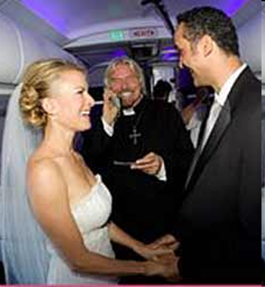
He has already officiated at one wedding in mid-air. Last year he was ordained for the day in an online church to marry Virgin America marketing director Dimitrios Papadognonas and Coco Jones on a Virgin flight from San Francisco to Las Vegas.

image

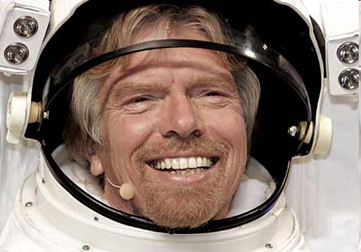
Record breaker: Sir Richard


He also helped officiate at the wedding of Google co-founder Larry Page on his private island, Necker, in the Caribbean.

A spokesman for Virgin Galactic told The Mail on Sunday: "We have had two bookings involving marriage, one to get married in space and the other for the couple to have their honeymoon in space.

"It is possible that Richard could obtain a licence to conduct the marriage."

The couple who have booked in for a honeymoon on the £100,000-a-ticket maiden flight are Virgin Galactic adviser George Whitesides and his new wife, Loretta Hidalgo.

The Virgin Galactic space project is progressing at a dramatic rate and customers will take part in the first test flights this summer.

In January, Branson unveiled a model of SpaceShipTwo, the vehicle he promises will turn space tourism into reality.

It is designed to hitch a lift on an aircraft to 50,000ft before blasting into the outer atmosphere. image

So far 200 people have paid for the sub-space experience. Princess Beatrice, whose partner Dave Clark works in the marketing department of Virgin Galactic, has said she plans to be the first Royal in space.

Former Dallas actress Victoria Principal, the designer Philippe Starck and wheelchair-bound Professor Stephen Hawking have also paid for trips.

The spokesman said: "Customers will have a two-hour flight, go up to 70 miles above the Earth and experience amazing views of the planet, G forces and weightlessness after a three-day training programme."

Branson has been involved in a number of world record-breaking attempts.

In 1986, he set a record for crossing the Atlantic in a powerboat. And in 1991 he crossed the Pacific in a balloon, breaking all existing records.

Friday, April 25, 2008

North Norfolk man's space dream

"EVERYBODY has a dream, mine happens to be expensive."

The words of Richard Burr, the north Norfolk man set to join an elite rank by becoming a 'space tourist' at the eye watering cost of $200,000 - around £100,000.

The 52-year-old property developer and businessman from Aylsham sits at number 205 on the list of people getting ready to board the first Virgin Galactic flights, which will allow ordinary folk to become astronauts.

Mr Burr has already stumped up £75,000 of the cash but still has something of a wait.

Those taking part will board a horizontally launched purpose built 'mothership' aircraft, which carries with it the spaceship, before being flown to a height where the spaceship can be detached and propelled into orbit. Two pilots and six passengers will be in the spaceship on each flight.

In January, Mr Burr travelled to New York to meet with other prospective astronauts, Virgin boss Sir Richard Branson and to attend the launch of the final design plans for the aircraft and spaceship.

The process now should see the finished aircraft and spaceship “rolled out” by July, tests conducted for several months, licences awarded and the first commercial flights by the end of next year, said Mr Burr.

“Because I am not top of the list I would expect to be up in early 2010, although that could change of course according to the process taking longer, or people dropping out.

“It's very exciting of course, but I wouldn't say I was excited in a schoolboy way, although that will probably come as it nears.

“The prospect of looking out of the window and seeing the stars and the earth is an incredible thought.

“People will think it is a huge amount of money, but bear in mind that if you look back to the first trans Atlantic flights, people were paying what would now be around £30,000 to get to America.”

The trip itself will be made from New Mexico and will last about two hours, made up of an aircraft climb of an hour, a spaceship boost into space in less than two minutes, a 'zero g' weightlessness experience of four to five minutes, a re-entry into the atmosphere of two minutes and a glided landing of 50 minutes.

Virgin Galactic have stated they hope to fly 500 people in the first year and 50,000 in the first 10 years.

Visit www.virgingalactic.com for more information.

Monday, March 31, 2008

Explorer Anousheh Ansari brought space down to Earth


She is the first to sniff space and declare that it smelt like a burnt almond cookie.

In September, 2006, Anousheh Ansari became the world's first private female explorer and, without realizing it, the voice of the quotidian observer of the unknown.

She brought space down to Earth.

The first Iranian-born person in space described the difficulty of washing her hair in zero gravity and of her "internal organs doing a cha-cha inside my belly" when the Russian space capsule, Soyuz TMA-9, started its orbit of Earth before docking for an eight-day visit to the International Space Station.


"What happened with my blog and all the attention I was getting was unexpected," she says during a recent visit to the Ontario Science Centre in Toronto. The daily blog, the first to be written from space, received more than 50 million hits and elicited comments from people around the world.

"A lot of people saw hope," she says. "They were looking at me as one of the most unlikely candidates to be able to do something like this."

In fact, her journey into space is less impressive than the one that got her to the launch pad.

Five years after the Iranian revolution in 1979, she and her younger sister immigrated to the United States with their parents, who wanted their children to get a good education. When they arrived, they lived with an aunt for several months. They were not a wealthy family. "When we left, we basically left with nothing," she says. "We just packed our bags and came."

The transition to American life was not easy. A teenager of 17, she didn't speak a word of English. "Teenagers are a species all by themselves," she says. "They can be cruel, not warm and welcoming at times. I was just in high school to study. I just went to classes and did what I had to do."

She even had to shelve the idea of becoming an astronaut, which had been a dream from childhood. "When I came here, I thought to myself, 'I can be an astronaut now. I'm in America.' That's what I wanted to do - study astrophysics and become an astronaut ... [but] I wasn't a U.S. citizen and I figured, 'Well, what are my chances of becoming an astronaut?' I knew it was not very high, and I knew I had to study something so that I could get a job immediately out of college to support myself and help my family."

So she completed a degree in electrical and computer engineering followed by a master's in electrical engineering. "I had read that electrical engineering and telecommunications, especially, were a grow- ing field," she offers with a shrug in her finely tailored clothing.

In the early 1990s, she persuaded her husband, Hamid, and her brother-in-law, Amir, to help her start Telecom Technologies with their combined savings.

In 2001, the company was bought by Sonus Networks for about half a billion dollars.

Ms. Ansari had still not lost her passion for space. "When we had employee meetings, I would make all my managers dress up in Star Wars costumes, and they would enter the room with Star Wars music playing," she says with only a suggestion of a smile breaking her serious composure.

It was a meeting with Peter Diamandis, chairman and founder of the X Prize Foundation, a non-profit educational organization, that would lead to her space travel. Mr. Diamandis was seeking funding for a competition that encouraged entrepreneurial initiatives to build the first non-government piloted spacecraft. He had heard of her fascination with space.

Ms. Ansari and her family decided to be title sponsors with a donation of $10-million (U.S.). Subsequently renamed the Ansari X Prize, the money was awarded in 2004 to Microsoft co-founder Paul Allen and well-known aviation designer Burt Rutan for their Space-

ShipOne.

The family also announced a partnership with Space Adventures Ltd. and the Russian Federal Space Agency to create commercial space vehicles. To understand the training required for space travel, and as a back-up to a civilian adventurer who was scheduled to fly, Ms. Ansari spent six months at Star City, the Russian cosmonaut facility outside Moscow. Already fluent in English, French and her native tongue, Farsi, she had to learn Russian. "Only three weeks before the flight, they told me that the person who was supposed

to fly failed his medical exam, and I had the opportunity

to do it. It was a complete

surprise."

The flight cost her $20-million. "The most memorable moment was when I first saw Earth from Soyuz. It was very emotional. I was crying," she says. "It was beautiful, an amazing image. It has been a year and a half, and I can see it, still, when I am telling you about it. There's almost a warmth coming from Earth. It is sort of glowing, and it's surrounded by darkness. It gives you a certain energy. You can feel that it is alive."

Since her return to Earth, Ms. Ansari has continued her upward trajectory with a guest appearance on Oprah Winfrey's television show and other talk shows, frequent invitations to speak and a memoir under way.

Commercial space travel will have a profound effect on the way people see the planet, she says. "When you're up there, you do look at the world differently. You do see a lot of possibilities for people working together. You see it as one. You're not looking at your country or your hometown. You're looking at Earth."

In 2006, with her family, she started another company, Prodea Systems, which is developing products for "the digital home" that would integrate services through the television, as one example. "The goal is that new technologies and services would be accessible to everyone, regardless of their technological savvy," she explains.

While her motive is entrepreneurial, it is more social than economic, she says. "Technology doesn't recognize any difference in race or religion or age ... and it has made us closer. It has cut through language barriers and distances."

Her schedule is hectic, the 41-year-old admits. "I spend 10 or 12 hours in the office working, and I think, 'Why am I doing this?' And I remember that I am here for a reason. I have a purpose. ...

"I think that 20 or 30 years from now, people will look back at this time as a great era of evolution for our species."

SARAH HAMPSON

Source

Friday, March 28, 2008

Space planes 'to meet big demand'

image

Aerospace giant EADS says it will need a production line of rocket planes to satisfy the space tourism market.

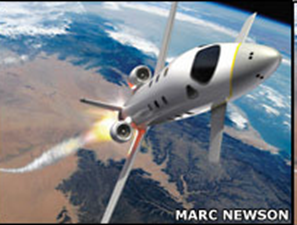
The European company's Astrium division, makers of the Ariane rocket, has plans for a commercial vehicle to take ticketed passengers above 100km.

Its market assessment suggests there could be 15,000 people a year prepared to part with substantial sums of money for the ride of a lifetime.

Astrium anticipates it be will be producing about 10 planes a year.

"To satisfy the market you will need more planes than you think, because once there is regular operation, the price will decrease which means there will be more customers," Robert Laine, chief technical officer (CTO) of the pan-European company, told BBC News.

image

"It will develop towards a classical aeronautical business model. Someone will build the planes; somebody will operate them; somebody will sell the tickets; somebody will provide the accommodation - like any tourism."

The first tickets will retail in the region of 150,000-200,000 euros (£115,000-160,000).

Mr Laine was speaking in London at the Institution of Engineering and Technology, where he was delivering the 99th Kelvin Lecture.

Astrium does not intend to run a space tourism marketing operation itself. Rather, it intends simply to supply vehicles to those who will.

And although production numbers will not be in the same league as, say, Airbus or Boeing, they will be significant nonetheless.

Mr Laine said development of Astrium's rocket plane was proceeding apace.

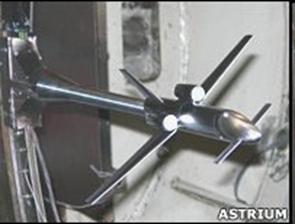
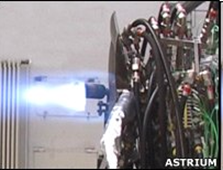
Wind tunnel testing has proven the aerodynamic shape; and the vehicle's Romeo rocket engine which will take the plane above 100km has been ignited for burns that have run up to 31 seconds.

The engine will be using the combustion of a liquid oxygen-methane propellant to provide the more than 1km/s punch needed to break through the top of the Earth's atmosphere.

About 50% of the mass of the plane at take-off would be fuel.

The intention is to produce a vehicle that seats five individuals - one pilot and four passengers.

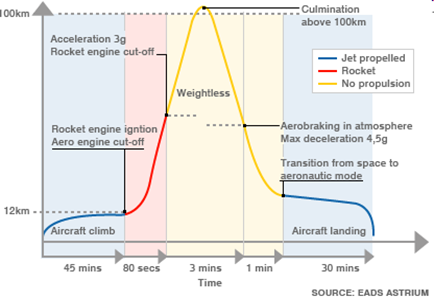
The production model will use normal jet engines to take off and climb to 12km.

From there, the rocket engine will kick the vehicle straight up, taking it beyond 60km in just 80 seconds. By the time the rocket shuts down, the craft should have sufficient velocity to carry it above 100km - into space.

image

As the plane then begins to fall back to Earth, the pilot will use small thrusters to control its attitude, keeping the plane's belly flat to the Earth.

"If you enter with the belly flat down then you expose a very large radius to the aerodynamic flux and that contains the temperature to an acceptable limit," explained Mr Laine.

"We calculate the temperature will be less than 100C on the surface of the wings."

When the plane slows to subsonic speed in the atmosphere, it will use its jet engines again to return to the airport.

image

The total journey time will be about one-and-a-half hours.

Mr Laine said the planes would have about a 10-year lifetime. They would be designed for ease of maintenance, with an operational schedule of one flight per week.

Although the rocket planes could take off and land from any airport, Astrium believes it is likely that special spaceports - possibly 10 worldwide - will operate in a few, restricted locations.

Northern Europe probably would not host one of these, Mr Laine speculated, because of the high density of other air traffic and because cloud would too frequently obscure the view of Earth.

"In Europe, I'd say the most likely location is around the Mediterranean. Why? Because there are blue skies most of the time, and because from 100km you can see mountains, the sea and the coast."

Cheaper space

The Astrium CTO acknowledged that Virgin Group boss Sir Richard Branson would be first into the market with rocket planes based on the award-winning and record-breaking SpaceShipOne concept.

But Mr Laine was confident an Astrium-fed business would be second, with a commercial service that began exactly five years after the agreement of a one-billion-euro financing deal.

He even hoped Sir Richard would be an Astrium customer - just as his airline business is a customer of the EADS Airbus division.

The CTO would not say how soon the initial financing would be in place, or reveal details about the identities of parties that were in discussion.


Long-term, Mr Laine said, space tourism had a major role to play in reducing the overall cost of space access.

He sees rocket planes being used for homeland security purposes as "quick satellites"; and as forerunners of superfast intercontinental passenger transporters.

"Today we don't know how to go to space cheaply. Being able to climb on a regular basis to 100km will give us the motivation to develop the plane that goes, not just up and down to the same place, but from here to the other side of the Earth.

"When the Ariane 5 takes off, 15 minutes later it is over Europe; and 45 minutes later it is over the Pacific. The fastest way is to go outside the atmosphere and that will be the future."

BBC

Tuesday, March 25, 2008

Branson and his rocket


A few months ago, an Australian stand-up comedian who is beyond cure, told a small frigid gathering in Mumbai, "How can they call an airline Virgin. It's terrifying. You know what virgin means? Never done it before." He surveyed the room with a blank face and said, "I want my airline to be called Slut."

In the past, far more serious men have wondered if people will feel comfortable flying at nearly the speed of sound, 10 kilometres above the earth, in a pressurized metal capsule called Virgin. Especially if they knew that the airline is owned by one Richard Branson who has escaped death on several occasions while trying to set speed records in planes, balloons and boats. He rappels down buildings too, and has aborted at least one such attempt midway after a sudden backache that wise women will call ‘age'. Yet, thousands have paid him good money against a promise that in about three years he will send them to space. Over 60,000 people have registered with his Virgin Galactic, 200 of them have even paid the entire ticket price of $200,000. One man exchanged his Virgin Atlantic frequent-flier miles for his seat. They hope to leave a golden desert in California and shoot 100 kilometres into space. "They will return too," Branson says, "Virgin Galactic is not where you send your mother-in-law on a one-way flight."

He is in his suite at the Hilton in Mumbai. Somewhere behind him, through the large indestructible glass window, I can see the Arabian Sea ablaze in the afternoon sun. Some people are hovering around in the room, one of them is his blonde secretary whose stretch pants seem aghast at the tightness of it all. And she sounds like a man.

Branson looks pensive and unremarkable. Even mature. But the folklore around him is inescapable. A 57-year-old Englishman who is believed to be worth about $8 billion; head of an empire that is involved in aviation, rail, energy, telephony, condoms, pickles and leisure, who famously said that he did not know the difference between net and gross; once a lover of many; a rare celebrity who has featured in a list of Britain's most beloved and also the most hated; a spectacle whose autobiography is foolishly called Losing My Virginity, and more admirably, a man whom Donald Trump hates for reasons other than the fact that Branson has hair. "I don't believe he is a billionaire," Trump once said. Nobody believes that about Trump, either.

In the opulent suite, Branson tries to be polite and measured but he is evidently tired. That morning he had strung himself 20 floors above the ground and glided down to launch Virgin Mobile in India. He was in a few meetings after that, all vouchsafed with stringent time slots by his assistants. But he was five minutes late for this interview because Sameera Reddy, the buoyant nymph, had spotted him in the hotel and had wanted a chat.

Branson readily admits that his flamboyance endangers the image of Virgin as one of the most respected brands in modern times. He looks at the floor and chuckles as he remembers the day when his balloon crashed into the Pacific. "We took out full page ads in newspapers that said, ‘Next time, Richard, take the plane." (Strangely, in an interview to the New Yorker he had said that the wording of the ad was, ‘Come on, Richard, there are better ways of crossing the Atlantic'.)

"In this time and age, the things I do," he says, "is achro...anarcho...sorry... anachronistic. Actually, I am dyslexic." Taare Zameen Par missed this one. He is overtly embarrassed by the ordeal of pronouncing anachronistic. This shy face of Branson, so different from the image he has often tried to portray, this boyish sheepish face, I have seen before from as close.

Just over two years ago, his executives had agreed to play a cricket match with Mumbai's press club team. Branson arrived on the Oval Maidan flanked by a dozen white girls, all dressed in Virgin Atlantic's cabin crew uniform. They walked like doe. When Branson eventually got ready to bat there was a feeling that we will not measure up. The rumour was that the backyard of one of his homes was a cricket field complete with a pitch and all that. But he was bowled by the first ball. Since it was Richard, the umpire smiled kindly and called the delivery a no-ball. The second ball was slow. Branson was bowled again. He was bowled by the third ball too. I was at the Third Man position and as he walked back, I saw his face clearly. Beaming but demolished by embarrassment. However, for a man who did not know how to bat, he got a lot of publicity for playing cricket in Mumbai. He didn't field even.

"I am actually very shy," Branson says, "I was incapable of delivering a public speech until I was 25. Now I make half a million for just talking for charity. Not bad, eh? But I am still shy." Yet, he has received media space worth millions of dollars through relentless stunts. Once when British Airways, his bitter aviation rival, offloaded him from a flight, he held a press conference in the airport and made it a huge media event. British Airways was also involved in spreading propaganda against him. When he sued and won £610, he distributed it among his employees as "BA bonus". On another occasion, when his flight was delayed and he had to hire a chartered plane for $2,000, he divided the cost by the number of seats and went around the airport with a board that said something like, "Virgin Atlantic: Beef Island to Puerto Rico for $39".

Branson, through the creation of Virgin Galactic, comes across as a visionary today. So far, only 450 humans have ever been to space, almost all of them professional astronauts. Branson says he will send thousands out there. But some observers have voiced the concern that Branson's interest in space tourism is merely another attempt to seek publicity if not for himself, for the Virgin group. With an investment of about $120 million, an amount that is not very distant from how much global firms spend on brand building, Branson has bought the tag of space pioneer. A steal. But he says, "I am truly very excited by space tourism. I believe that the future of mankind is in space. Virgin Galactic will send 50 people to space every month. I expect this number to grow." He also believes that the future of aviation itself is inextricably linked to suborbital space travel. "In just 10 years time if everything goes well," he says, a plane from New York will head to space and use the gravity of Earth to fling itself above Sydney. "If we can bring that kind of technology to aviation, New York to Sydney is possible in 30 minutes."

His involvement in environmental concerns too is bitterly suspected by environmentalists. They claim his interest is not genuine, that he merely wants to throw money to buy a halo. Throughout the interview Branson consciously attempts to veer the conversation towards environment. He reminds me that he has pledged $3 billion over the next 10 years to aid the research and development of cleaner fuels. He has also announced a $25 million prize for anyone who can find a way to remove carbon from the atmosphere.

"Increasingly, private enterprise is doing what governments used to do," he says, "Also, while the life of an average head of state is just a few years, a business chief can go on for decades. So companies are able to exhibit more stability than governments. But nothing can replace the good that an honest government can do."

It will be interesting to watch how Branson's future unfolds. Will his space tourism succeed? Will his billions clean the air? After all the publicity, if he fails to deliver then he will begin to feel as though the world has got a whiff of the liquid component of his SpaceShipOne's hybrid engine—compressed nitrous oxide, which is laughing gas of course.

Thursday, March 20, 2008

Lottery-winning beneficiary: I'm heading to space

An Auckland beneficiary who bought a lottery ticket on a whim is more than $5 million better off and hopes to travel into space.


The man, who wants to remain anonymous, was on a bike ride when he had a spur of the moment drink stop outside the Westview Superette in Titirangi, NZ Lotteries said.

After seeing an advertisement for the Big Wednesday jackpot, he bought a ticket, and yesterday discovered he was the big winner.

He won the first division prize package valued at $5,247,140, comprising $3 million in cash, an Aston Martin V8 Vantage, an Audi Q7, a $250,000 credit card, $250,000 worth of luxury travel, a $500,000 bach, a $750,000 luxury apartment and a boat.

He also won Big Wednesday's second division of $221,478 by covering heads and tails on his ticket.

The man collected his prize in Wellington today.

"People have always told me that you can't win these big prizes - but now I'm the lucky bugger this week", he said.

"I also want to look at travelling in real style - by booking a trip into space. It would be great to one of the first kiwis to make that trip."

Virgin founder Richard Branson is finalising plans to take paying passengers into space next year.

Virgin Galactic will take people 112km above the earth for about $200,000 per person.

The winner said his first call was to a family member to share his good news.

The next call? To Winz to cancel his benefit.

NZPA
source

Sunday, March 16, 2008

You may now float about the cabin


'SPACE: The final frontier, to seek out new life and civilisations." So said Captain James T. Kirk of the Starship Enterprise as he surveyed the expanding cosmos.

But exploration, discovery and adventure are not the sole domain of science fiction: they have always been defining elements of the human psyche.

Once mankind satisfied the lesser, more fundamental requirements such as food, shelter and community, we looked beyond the horizon and wondered, "What if?"

Sure, it took thousands of years for our sluggish and humble species to progress from canoes to steamships, yet much less than one hundred to go from powered flight to space travel.

From a traveller's perspective, now is the most exciting time in our species' existence.

Such have been the astounding technological advances that, in one lifetime, man has flown to the moon and now transverses every continent at an altitude of 30,000ft in the company of hundreds of others, enjoying the latest movies and gourmet meals in pressurised comfort. To many, it's even mundane.

Space travel fell somewhat flat after the Apollo program. Many pundits, such as sci-fi writer Arthur C. Clarke, predicted we'd be sticking flags in Mars and holidaying on the moon by now.

Somewhere along the way we were sidetracked – probably because our expensive, clumsy rockets weren't as reliable as we'd hoped. This is World War II technology, after all.

Riding what amounts to a ballistic missile still hasn't deterred some, despite a pricetag equivalent to the GDP of a small African republic.

At time of writing, there have been five "spaceflight participants" aboard the Russian Soyuz craft, each traveller paying a reported $20 million for the week-long joy ride to the International Space Station (ISS).

Tickets are now being sold for a planned flight to orbit the moon. Price? $100 million each.

Affordable space flight? Enter the X PRIZE Foundation, a non-profit body offering multi-million dollar awards for technological breakthroughs. The 2004 Ansari X PRIZE was won by famed aerospace designer Burt Rutan and financier Paul Allen, who led the first private team to build and launch a spacecraft capable of carrying three people 100km above the Earth. Pounced upon by Virgin supremo Sir Richard Branson, commercial flights are now tantalisingly close.

Branson's Virgin Galactic spaceline expects to launch about 500 passengers annually.

His proposed fleet of five spaceships will have a crew of two and just six passengers, paying US$200,000 ($215,000) each, flying to an altitude of about 110km – the very edge of space – to experience almost 10 minutes of weightlessness.

Unlike NASA's Space Shuttle, which uses huge and dangerous solid fuel rocket boosters, Virgin Galactic's SpaceShipTwo will launch from a jet-powered mother ship called WhiteKnightTwo, and use a single hybrid rocket motor to reach its peak sub-orbital altitude. And because the craft will only travel at around 4000km/h, it will not require heatshields for re-entry.

Branson appointed "space agents" last year, and Gil McLachlan of Harvey World Travel in Manly is one.

"There are at least 10 Australians fully paid up for the flight," said Mr McLachlan, "and there will be more in the next 12 months, for sure."

One such passenger eagerly awaiting his moment on the launch pad is Wilson da Silva, editor of Australian science magazine Cosmos, whose ticket was one of four bought by Dr Alan Finkel, the publication's chairman.

"Hard to believe that it's really going to happen," says da Silva with obvious delight. "It's been a dream of mine since I was a kid."

In Clarke's seminal 1968 work 2001: A Space Odyssey, Dr Heywood Floyd settles into the Orbiter Hilton for a family video call at a rather clunky terminal.

The choice of the Hilton name for that movie was no coincidence; it was a carefully engineered piece of product placement. William Barron Hilton I, the hotelier and grandfather of the famous Hilton sisters, bravely predicted in 1967: "When space scientists make it physically feasible to establish hotels in space and to transport people, the hotel industry will meet the challenge."

Beyond an orbiting hotel, his plans extended to the Lunar Hilton. "To start, we'll have only three floors, which will eliminate elevators and minimise power requirements," he said.

"The multi-storied underground hotel will come later.

"But – and this is very important – in almost every respect the Lunar Hilton will be physically like an Earth Hilton."

But Hilton appears to have lost the inside running to Branson and Robert T. Bigelow, a rival hotelier who is now an aerospace magnate. His Genesis modules are already in space, testing the concept of inflatable habitats for possible "hotel" adaptation.

For most of us reading this far, the reality of space flight will remain a fantasy, experienced vicariously in the Sensurround stadium of the cinema.

But the excitement of weightlessness can be achieved at Kennedy Space Centre, in Florida, on a Zero Gravity flight aboard G-Force One, the plane used to train NASA astronauts and film star Tom Hanks for Apollo 13. For $3500, you even get a DVD of your flight. I predict, however, that theme park, holodeck-style virtual reality will cater for the masses long before actual space flight does.

After all, it was to such a synthetic environment that Star Trek creator Gene Roddenberry's homesick space adventurers went to "get away from it all".

As for the visionary Roddenberry ... his one-way trip into space was in an urn.

The Sunday Telegraph

Thursday, March 13, 2008

Sharaf Travel & Virgin Galactic Mid East tempt would-be astronauts with 'a taste of space'

Dubai headquartered Sharaf Travel and the Virgin Galactic Accredited Space Office in the Middle East has launched “A Taste of Space”. The new package has been designed to tempt would-be astronauts for the Virgin Galactic sub-orbital flights slated to commence end of 2009.

“Following the Global Accredited Space Agent Forum earlier this year where I underwent  the Virgin Galactic astronaut training  in the centrifuge for myself, I wanted to make this experience available to the people of the Middle East. ‘A Taste of Space’ is definitely for people looking for something unusual for their next short break and will give potential customers the opportunity to quell any fears with the nearest thing to real-life space travel without leaving earth,” said Sharon Garrett, Head of Space Marketing & PR, Virgin Galactic Accredited Space Office, Middle East.  

According to Garrett, the training for the sub-orbital space flight at the Nastar Centre will equip participants with the skills they require for Anti-G Straining Maneuvers and to fully understand the physiological effects of space flight before they even set foot into the centrifuge.  

“The training is fascinating, yet easy to understand.   The team at the Nastar Center make you feel incredibly comfortable and instill confidence.   I know that everyone who decides to take advantage of ‘A Taste of Space’ will sign up for the real thing with Virgin Galactic,” she said.

Explaining her own experience, Garrett says, “…the experience was one of the best of my life. I was a little anxious but once I underwent the training and stepped into the centrifuge, which is kitted out with full visuals and sound I had the most wonderful time. I felt as though I really was an astronaut !”

Tuesday, March 4, 2008

The Stars: Our Destination

Vacations in space and time

Forty years ago it was “one small step for man, one giant leap for mankind.” Now it is a small step for anyone who dares.
For the last four decades, space flight has been neglected as a primary conduit to human evolution. Popular opinion sees space flight as a sidebar to human development. Even NASA, with their use of aging, decrepit and obsolete shuttles, appears to believe the same. But fear not, for our savior has arrived in the form of a virgin. Well, the Virgin Galactic program that is. Virgin has taken the initiative in commercializing space

Image courtesy of virgin galactic, design by sky 26
travel as a luxury for those who can afford it

image

The dream of everyday space flight has been around a long time. But, while science fiction has been escalating in the last decade with advanced computer-generated graphics, society has largely forgotten actual space exploration. In the mid-20th century, the United States and the former Soviet Union were feverishly involved in pushing space exploration. It seemed that, like in Star Trek, space exploration was best executed by the government.
In the 1980s, NASA began to launch shuttles that took off from and landed on Earth more than once. These shuttles cut down on the cost of development. The down side of the shuttle, however, was they offered no progression. The need to develop new models was minimal.
Since then, however, the idea of international cooperation has inspired multiple governments to join together and build the International Space Station. Bent on scientific discovery rather than territorial expansion, the station has ended much of the exploration being done by governments. The weight of exploration is now left to the private sector. With little room being left on Earth to expand empires, corporations like Virgin have seized the opportunity to expand their market into space. It offers free expansion as no one currently owns space.
Further initiative came from the Ansari X prize. It inspired innovators and dreamers to build the first commercial sub-orbital space craft. Many competitors strove to reach the goal and win the prize: $10 million. It was a company named Scaled Composites, founded by Burt Rutan, that eventually designed the winner. Named SpaceShipOne, it flew at an altitude of more than 100 kilometres. The design of SpaceShipOne is simple and efficient, which makes it significantly less expensive than NASA’s fuel-guzzling shuttles.
SpaceShipOne uses a form of biofuel. The fuel is practical enough to allow the ship to reach sub-orbit, but requires less than half of what a normal shuttle does. To achieve optimal efficiency, Scaled Composites attached the SpaceShipOne to WhiteKnightOne, an aircraft. Instead of launching from the ground, ShipShipOne launches after becoming airborne. This technique allows for even more efficiency.
The ship’s efficiency was what drew Virgin’s Sir Richard Branson. The company was inspired to begin its own attempts at building a commercially viable passenger space craft. Based on the SpaceShipOne’s design, SpaceShipTwo has become Virgin Galactic’s platform for allowing private citizens to visit space.
“It was Stephen Hawking who first got me thinking about this issue when he explained clearly and concisely to the BBC that mankind had no option but to get to space as quickly as possible and start doing things up there that we have been doing on planet Earth, but in a much more efficient manner,” Branson said at SpaceShipTwo’s unveiling.
Branson seemed sincere when he said that space flight is essential to human development. Without prospects of commercial success, however, Virgin Galactic would be unable to justify their investment to stockholders.
That profit requirement means a ticket to space does not come cheap. Current pricing places the cost of a ticket at $200,000 US a seat. The ticket will buy tourists a several minute journey at sub-orbital altitudes.
Though the initial price of a ticket will prove far out of reach for most consumers, it is expected to incrementally decrease as the program continues to pick up speed. After a few years and a few hundred people, the price of a ticket will most likely go down to $20,000 US a piece.
There are others, however, who are finding a way around paying the hefty fee. A British businessman was able to exchange two million Air Miles points for a ticket aboard one of the first flights. However, for the majority of people, $20,000 is far too expensive, even if it is to witness something as spectacular as seeing planet Earth from space. 
Yet Branson sees this as just the beginning of better things to come for the industry.
“With the end of the oil era approaching and climate change progressing faster than most models have been predicting, the utilization of space is essential not only for communications but also for the logistics of survival through things such as weather satellites, agricultural monitoring, GPS and climate science.”
Not only would space be a reasonable way to guarantee survival of the species, it would also guarantee optimal profit should Virgin Galactic hold a monopoly on commercial space flight. However, without a profit, there would be no motivation for space tourism in the first place.
Several companies, such as Rocketplane Limited, Space Adventures and EADS Astrium, have announced their intention to be commercial spaceflight agencies. There is no doubt that in the future, spaceflight will become a standard of travel.
For Virgin Galactic, however, tourism is just the beginning. The company will most likely expand from tourism to a more lucrative industry like transportation from one side of the Earth to the other. Instead of taking a day to travel to Japan, a spaceship capable of holding up to 100 passengers could cut that time significantly.
The advantages of commercial space flight are numerous. Its ability to push innovation is already taking the place of NASA. Government will always play a role to some degree, but ventures such as asteroid mining, solar energy collectors and colonization will be ideal for corporations to invest their time and money into because of the potential for maximum profit.
Although governments could plan and build environments on other planets to house humans, it would be capitalism that forces the economy and infrastructure. What drives people to exotic places is not just a sense of adventure but, like with any new frontier, the possibility of discovering a better life with better job opportunities. Those jobs will be provided by companies like Virgin.
Relatively speaking, there are still more than enough complications prolonging spaceflight developments. While interplanetary exploration is accepted as a future prospect for mankind, interstellar spaceflight is a bit more complicated with the vast gaps between stars. It would currently take centuries to get to the nearest star systems using the most powerful propulsion methods currently available. Though most of us will not be able to see the interstellar steps, we will be alive to see the first true steps of space exploration.


Written by Brent Rose, Contributor

Wednesday, February 20, 2008

Audley Travel boss books space flight with Virgin Galactic

Audley Travel boss Craig Burkinshaw (pictured below) will experience the trip of a lifetime when he boards a Virgin Galactic spaceship.

The Oxfordshire-based businessman, who heads up the specialist tour operator, has spent £100,000 to be one of the first space tourists.

image

He said: “It’s a lot of money but I want to be among the first. I’ve done skydiving many times and travelled all round the globe, but this is going to be fantastic. I want to see the Earth the way astronauts see it.”

Launch and landing points will be in New Mexico and the journey will last an estimated 150 minutes. On each trip there will be just six passengers and the spaceship will reach a height of 100km, just past the Earth’s atmosphere.

source

Wednesday, February 13, 2008

Space flight experience at a bargain price

image

A promotional shot of Virgin Galactic's Spaceship Two.

If a $260,000 flight into space busts your budget then maybe the $23,000 sub-orbital space flight training is more up your alley.

Open to the public for the first time, the simulation has been designed to mimic an intergalactic experience.

Three Australian travel agents have recently returned from the Virgin ASA Global Forum in the US where the Virgin brainchild was launched.

But the ride comes at a cost.

Virgin is planning on putting together half day (about $2030), full day (about $3390) and two-day (about $5645) packages for space junkies.

Edwin Spencer, director of Spencer Travel in Sydney, said that the simulation conveys what a trip in space is like, however the G forces on the ride are a little lower. He thinks that it is worth the cost.

"You get the exact same experience as if you were going to do one of the flights (into space)," Spencer said from the conference in Philadelphia.

"They (Virgin) are trying to promote this facility to give you the experience of what it would be like on a space flight. It's so deadly accurate."

Having said this, Spencer admits that it's not for everyone.

"I think by the time you package it all and you get them over here it's probably going to cost about $20,000, with airfares and accommodation.

"... It's not going to appeal everyone but it's brand spanking new ... it's something really really unique.

"The big boys toys kind of people. The guys that love the adventure."

The travel packages will include the sub-orbital space flight training in Pennsylvania and the longer sessions will also include training on a parabolic flight and fighter pilot training in Las Vegas.

Spencer Travel, accredited as a Virgin Galactic Space Agent, sold Australia's first fully-paid ticket to space last year.

The journey into space takes two and a half hours to fly up 15,240 metres. The mothership then drops the rocket and it is sent soaring to 116,000 metres.

To put it into context, a standard aeroplane flies at about 9000 metres.

Passengers then experience five minutes of weightlessness before being returned to earth.

The $260,000 journey takes just a day but involves two days training.

The first 100 visitors to go into space, deemed Founders by Virgin, are expected to make the trip in 2010. Most positions on the Founders team were invitation only, but one fully-paid female from Australia made the rollcall.

"She is determined to be in the first 100," Spencer said.

The space-loving customer wants to keep a low profile, but Spencer said that she is an adventurer.

He said that space travel hadn't aroused the same excitement here as it had in the US.

"It's not that big in Australia but in the US it's huge," he said.

"This is just the beginning. It's the ultimate experience in life.

"It's that whole concept of being able to see Earth out of the left hand porthole and space from the right hand porthole."

IF YOU GO:

Visit: http://www.spencertravel.com.au

Saturday, February 9, 2008

Kiwi space hopefuls at Virgin Galactic unveiling (+photos)

1

Two New Zealanders who hope to become the first Kiwis in space were in New York last week for the unveiling of Virgin Galactic's launch system.

Christchurch real estate agent Jackie Maw and businessman Mark Rocket, a space enthusiast who changed his name by deed poll, have bought $280,000 tickets on one of British entrepreneur Sir Richard Branson's space journeys, scheduled for late next year or early 2010.

The three-hour trip will take them 112km above the earth.

Established in 2005, Virgin Galactic successfully launched its SpaceShipOne craft into space in 2004, winning the $10m Ansari X prize for the first non-government organisation to launch a reusable manned space craft into space twice within two weeks.

With SpaceShipTwo and its "mothership" launch vehicle, White Knight Two nearing completion at the Scaled Composites plant in California, more than 200 people worldwide have signed up and paid deposits for space trips.

Ms Maw said the seriousness of the project hit home to her at the design unveiling in New York.

2

3

4

"It is not just about sending passengers into space as a commercial venture," she said in a statement today.

"While that is part of it, we are in effect a source of capital which is enabling developments and exploration which will change our world."

Ms Maw, who has already completed an astronaut training course at the National Aerospace Training and Research (Nastar) centre in Philadelphia, said it was "incredibly motivating and exciting" to know those involved were part of that exploration.

Mr Rocket, co-director of Rocket Lab, a company that hopes to put New Zealand's first rocket into space this year, was the first New Zealander to buy a Virgin Galactic ticket.

He classifies himself as a "space industry participant" as well as a Virgin Galactic founding passenger and said he was equally motivated by the unveiling and what it meant long-term.

The first 100 people to sign up and pay for their future flights were invited to the New York unveiling - a media event and cocktail party covered by 30 television channels.

Mr Rocket said while predominantly from the United States and Britain, people were there from all over the world, including small places such as Estonia and Morocco.

Coming from New Zealand "attracted interest, but was not seen as out of the ordinary", he said.

- NZPA


Source: nzherald.co.nz

Friday, February 8, 2008

The new form of travel - Virgin Galactic

image

Up, up and away ... Branson said he would like to see the company's second spaceport set up in Australia in 2006

INITIALLY dismissed as another Richard Branson publicity stunt, Virgin Galactic is starting to attract serious attention as the potential of the British entrepreneur's ambitious space venture hits home.

It may still be early days, but some observers are already cautiously predicting Galactic will be a turning point in the commercial development of space.

Virgin Blue chief executive Brett Godfrey is among those who believe the technology being developed by Branson's "spaceline" will quickly move beyond joy rides for the well-heeled.

Godfrey, who has paid $280,870 to be among the first to head into space when Virgin Galactic begins operations, can see the concept developing into a new form of travel.

The Virgin boss is far from starry-eyed about his pending trip into the fringes of space. He insists he did not have a lifelong dream to become an astronaut. Instead, he is keen on understanding a technological advance he predicts will produce important spin-offs. He believes there's no reason technology similar to that used by Galactic will not eventually be used for sub-orbital flights between continents.

Instead of cruising back down to the same place, passengers will be able to go to another spaceport on another continent, the airline executive predicts.

"The reason I've invested my money is that I want to be part of the technology and understand it as best we can because I believe this will be the way of the future," he says.

"If, in 10 or 15 years, we're not getting to London in 45 minutes from Sydney, then we will have gone backwards.

"And it doesn't have to be done at a higher fuel cost."

SpaceShipTwo unveiled

While Godfrey concedes that some people may see the venture as an excuse for rich people to spend money, he points to parallels when aircraft first started flying. "Now it's mass transportation," he says.

"I think we've got to look at alternative technologies."

He points out the value to business people of being able to cut down the time spent travelling between countries to just a couple of hours. "The blokes that own corporate jets today, what would they pay to be able to get to Los Angeles or New York or London within a couple of hours?" he says. "A fortune, I think."

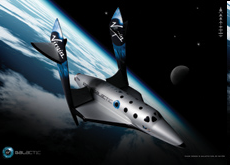
Virgin Galactic passed an important milestone last weekend as it unveiled the design for both SpaceShipTwo, the vehicle that will initially take eight astronauts into space, and White Knight Two, the twin-hulled mothership that will carry SS2 to its launch altitude.

The system is a successor to SpaceShipOne, the Burt Rutan-designed craft that won the $11 million Ansari X Prize after it become the first non-government reusable space vehicle to make it into space.

The original project was backed by a $20 million investment by computing legend Paul Allen – said to be the same amount NASA spent developing a pen that could write in space – although the Microsoft founder was not interested in commercially exploiting the breakthrough. This was when Virgin Group moved in to license the technology. White Knight Two is now close to completion at designer Rutan's Scaled Composites facility in California's Mojave Desert and is expected to start flight testing in the northern summer.

Go green machine

The world's biggest all-carbon composite aircraft has the wingspan of Boeing 757 and is powered by four Pratt&Whitney PW308A engines. It has been designed with the idea of lifting other payloads, such as small low-earth-orbit satellites, into space at costs significantly less than currently available.

SpaceShipTwo is about 60 per cent complete. It also has the flexibility to accommodate scientific and commercial applications.

Galactic now has more than 200 individuals and 85,000 expressions of interest from people wanting to experience space.

This translates to a deposit base of more than $31 million and $50 million in income to the fledgling spaceline.

The plan is to take the astronauts to a height of 110km in a sub-orbital flight that will give them about four and a half minutes of weightlessness.

There will initially be one flight per week but it expects this to increase to one or possibly two a day after operations move to its new spaceport in New Mexico.

The 18m spaceship, which will carry six passengers and two pilots and is about the size of a Falcon 900 executive jet, will hitch a ride to about 50,000ft before detaching from the mothership and igniting its hybrid rocket.

This sort of air launch is less fuel-hungry and environmentally damaging than a ground-based launch, and this is what allows the use of lightweight composites.

Scaled Composites is also looking for a more efficient and environmentally friendly fuel than the rubber and nitrous oxide combination that powered SpaceShipOne.

Reach for the skies

The climb to the maximum altitude will take about 90 seconds as the spacecraft reaches three times the speed of sound.

Shortly before the apogee, the spaceship will fold its wings as it prepares to re-enter the Earth's atmosphere. The feathered wings are designed to act as an air brake, significantly reducing the forces and heat on the craft during re-entry, until they are deployed at about 60,000ft for an unpowered glide back to the ground.

One of the big questions for passengers and regulators will be the overall safety of the program, which has not been without its mishaps.

Scaled Composites is still trying to determine the cause of a rocket explosion last July that killed three workers and resulted in occupational health and safety fines of more than $28,000.

Rutan admitted at the launch that the accident was delaying the engine's development but said he was confident the spaceship would meet its demanding specifications.

He told reporters that the flights would at least be as safe as air travel in the 1920s and hundreds of times safer than government-funded space travel had been so far.

Galactic has ordered five spaceships and two carriers for its initial operations but Branson makes no secret of the fact that he sees this as just the start.

Branson's space mission

It was the famous physicist, Professor Stephen Hawking, who got Branson thinking about the project. During a BBC interview, Hawking said that mankind had no option but to get to space as quickly as possible.

"Our population is now heading to 9 billion people by the middle of this century – that's three times more than when I was born," Branson says.

"With the end of the oil era approaching, and climate change progressing faster than most models have been predicting, the utilisation of space is essential not only for communications but also for the logistics of survival through things such as weather satellites, agricultural monitoring, GPS and climate science.

"I also believe that some day we will be able to use space as a source of energy for the planet, through solar power satellites, using the most sustainable source available &$150; our sun."

Branson also sees the potential for delivering satellites and for a sub-orbital, passenger-carrying vehicle, although he admits the later might not happen "for some time".

What part Australia has to play in the commercialisation of space, beyond supplying astronauts, remains to be seen. Branson said in 2006 that he would like to see the company's second spaceport set up in Australia.

By Steve Creedy, Aviation writer
Tuesday, February 5, 2008

Travel agent books seat into space

image

Travel agent Craig Burkinshaw is booked on a £100,000 trip out of this world.

The businessman, whose Witney company Audley Travel provides tailor-made holidays for anywhere on Earth, is going a little further himself, with a ticket to go into space.

He has paid a fee of $200,000 (£100,000) for Flight 32, seat 190, on Sir Richard Branson's Virgin Galactic, expected to become the world's first commercial spaceline.

Mr Burkinshaw, 37, last week took a training flight in the US to experience weightlessness.

He said: "We had just a short time of floating around, but on the real trip it will be up to five minutes.

"I can't wait, it's extre- mely exciting. I want that feeling again and to look at the Earth out of the window just like the astronauts."

The first commercial flight is now expected to be early in 2010.

Each trip will have six passengers, carried up to about 60,000 metres on an aircraft, when a rocket is released to zoom just beyond 100km, defined as the boundary of space.

The whole flight is expected to last no longer than two-and-a-half hours, costing about £11 a second.

Mr Burkinshaw said he was only too willing to pay.

"It's a lot of money but I want to be among the first," he said. "I've done skydiving many times and travelled all round the globe, but this is going to be fantastic."

And his girlfriend is quite understanding. "She knows I'm into astrophysics and all that sort of thing," he said.

"There's a lot of money going into commercial space travel and there's nothing to worry about."

Sir Richard's Virgin Galactic company unveiled a model of its vessel, SpaceShip Two, this year, and testing is due to start in the summer.

Its first flights are expected early in 2010, with take-off and landing in New Mexico, in the USA.

The first 200 passengers are now signed up to fly.

They have to undergo medical assessments, including whether they can withstand the G-forces of extra terrestrial flight.

An American company, Wyle, whose Life Sciences Group has four decades of supporting the space agency Nasa, has been brought in by Virgin Galactic to provide medical and management expertise to prepare passengers for spaceflight.

The cost of the 150-minute trip is £100,000, but Sir Richard, who has a house in Kidlington, has been quoted as saying it could go down to about £10,000 in a few years. If you fancy booking a flight, call the tour operator Elegant Resorts on 01244 897000.

By David Horne

Friday, February 1, 2008

Cosmic travel set to take off

Testing begins this summer on Virgin's new spaceship with launch expected to be in 2010

Last week, Richard Branson’s Virgin Galactic unveiled a model of SpaceShipTwo, the vehicle he promises will turn space tourism into a reality.

Fancy an out-of-this-world trip? Here’s the lowdown for potential high-flyers.

When can I go? Testing will start this summer. The first passenger flights were expected next year, but Virgin insiders say 2010 is more likely. How’s it done? While conventional rockets blast off from a static position on the ground, SpaceShipTwo will be carried up to 50,000ft by its launch aircraft, WhiteKnightTwo. After release, it engages its rocket engines to power on up to 360,000ft, or 68 miles above sea level, in 90 seconds.

What can I do up there? Float about, mostly. You’re high enough, at the apex of the flight, for the earth’s gravity to be pretty much unnoticeable. The period of weightlessness will be only five minutes or so during the 2½hour trip, but you’ll be encouraged to enjoy it – seatbelts off, and 7ft of headroom to bob about in.

Bad news for anyone wanting to test the carnal possibilities of zero gravity, though. Branson has made cracks about joining the 60-mile-high club, but, with eight aboard (six passengers, two pilots), there won’t be much privacy. There’s no loo to escape to, either – which means “Nasa nappies” may be used to prevent disasters. Hardly sensual.

What will I see? Don’t expect that humbling view of the faraway earth isolated in space that lunar astronauts found so moving – you’d have to go a lot further for that. But you will have a clear sense of the curvature of the globe, and views of 1,000 miles in every direction through the multiple 18in-wide windows.

Initially, that’ll be 1,000 miles of southwest USA – SpaceShipTwo’s Norman Foster-designed spaceport is being built in New Mexico. But Virgin Galactic has firm plans for launches from Sweden, and is in discussion with RAF Lossiemouth, in Scotland. If they go ahead, you’ll be able to fly straight into the northern lights – or take in the whole of the British Isles at a glance.

Who’ll be in the next seat? Stephen Hawking, Victoria Principal, the designer Philippe Starck and the environmentalist James Lovelock are among the 200 signed up to fly.

Do I have to be fit? You’ll have to go through a medical assessment and centrifuge training to see if you can withstand the G-forces. At one point, they’re expected to reach 6 g – “like an elephant sitting on your chest”, according to astronauts.

How safe is it? The maker, Scaled Composites, says that safety is at the heart of the design, and launch will take place only after exhaustive tests and approval by the US Federal Aviation Administration. But going into space is not the same as hopping on a jumbo. The company’s president, Burt Rutan, told reporters at the model’s launch that he was aiming at similar safety levels to the early airliners of the 1920s, rather than today’s standards. “Don’t believe anyone who tells you that a new spacecraft is as safe as a modern airliner,” he said.

What will it cost? You’re looking at about £100,000, though Branson says that the price may come down to as little as £10,000 in a few years. You could always use your air miles: Alan Watts, from Harrow, has paid for his entire ticket using Virgin Atlantic frequent-flyer points. He had 2m of them.

Anyone else doing it? Branson may be ahead, but there are plenty of others in the tourist space race – among them the Amazon.com tycoon Jeff Bezos, Elon Musk, the founder of PayPal, and EADS, the European consortium that owns Airbus. Its suborbital rocket is promised for 2013.

What’s the carbon footprint? It’s not good, but it’s not as colossal as you might think. Virgin Galactic claims that one astronaut’s emissions will be less damaging than those caused by a business-class return to New York – that’s about two tonnes of carbon. It’s looking at biofuel systems to lessen the effect.

How can I book? Direct with Virgin Galactic (www.virgingalactic.com ) or via its UK agent, the posh tour operator Elegant Resorts (01244 897000, www.elegantresorts.co.uk ). Yes, the same people who’ll take you to Sandy Lane.

Can’t I go a bit further? Possibly. The US company Space Adventures – which sent the first space tourist, Dennis Tito, to the Russian Soyuz space station in 2001 – is offering trips to the moon for a cool $100m, and says it could launch within four years of getting its first customer.

Source

Thursday, January 24, 2008

Serge Dive Interviews: Carolyn Wincer, Head of Astronaut Sales, Virgin Galactic


Sir Richard Branson always fantasised about space travel. So when Dr Peter Diamandis dreamt up the $10m (£4.8m) Ansari X-Prize - the inspiration for private space travel - aerospace engineer Burt Rutan, Microsoft co-founder Paul Allen and Branson teamed up. In June 2004, SpaceShipOne successfully completed her first test flight.

- What exactly is the Virgin Galactic experience?

It is a sub-orbital spaceflight which will be available to the paying public. Following astronaut training the space tourists take the SpaceShipTwo flight. The climb up to 50,000ft for the air launch will afford amazing views. After a brief freefall when SpaceShipTwo drops from her mothership, the rocket burn will push them back in their seats as the spacecraft accelerates to supersonic eye-watering speeds within 10 seconds of ignition, then to almost four times the speed of sound in 30 seconds. The sky turns from blue to black as they are propelled almost vertically out of Earth's atmosphere and into space.

The rocket engine will be shut off to reveal instant silence. Astronauts will have 1,000km visibility with the thin blue line of the atmosphere, the blackness of space and the curvature of Earth plain to see, all while floating weightless around the cabin. After a few minutes, they will begin to feel Earth's gravity pulling them back home, peaking at 6 Gs during a carefree and relatively heat-free re-entry. After a 45-minute glide back to the spaceport, they will greet their loved ones and be given their Virgin Galactic astronaut wings. All for just $200,000 (£96,900).

- How have Virgin Galactic sales gone to date?

Since 2005, more than 200 people from 31 countries have paid a deposit, and some 70,000 people from around the world have expressed interest. We also have over 82 'accredited space agents' in 17 countries, currently accounting for 50% of sales.

Tell us about the involvement you have had with Philippe Starck and Stephen Hawking...

Philippe is amazing to work with and we feel incredibly privileged to have his creative input. He provided the inspiration for our brand and ensures all aspects of design maintain brand integrity.

Professor Stephen Hawking has a deep desire to go to space and we hope to help him fulfil that. He has contributed so much to our understanding of the universe and inspired people to look for answers to some of the biggest questions ever asked - namely, how did we get here?

- Is space travel the future of luxury travel?

I think it is the new frontier of luxury travel. Within 10 to 15 years, people will be visiting hotels in orbit, shortly followed by holidays to the moon and hopefully beyond. I hope that in 40 or 50 years' time we will have managed to create a vibrant industry enabling tens of thousands of people to work, live and holiday in space, and one that has made positive contributions to the issues facing our planet.

- Which country will use Virgin Galactic the most?

The US is the most important, with around 50% of sales to date. Thankfully, our price is in US dollars so Americans are still comfortable with buying.

- Which luxury companies do you respect?

I hugely admire Virtuoso. Matthew Upchurch has created a dynamic and innovative organisation. He has unbelievable foresight: about 10 years ago when everyone else was saying that travel agents were a dying breed, he instinctively knew that travellers were always going to need them.

- What mistakes have you learned most from?

Thinking if successful companies do things a certain way there is a good reason for that, and we should do it that way too. It couldn't be further from the truth.

- What is the key driver for luxury travel?

Accessibility. As a destination or experience becomes more accessible, the high end of the market drops it like a hot cake and moves onto something more exclusive, or at the very least, more expensive. Only product innovation, coupled with courage, can keep a company exclusive in the eyes of the luxury traveller.

- What advice would you give the industry?

Define your values as a company. Words like 'honest' and 'exciting' make excellent brand values.

- Serge Dive is one of the three founding members of the International Luxury Travel Market, held in Cannes.